info@clicktranss.com


Table of Contents
Introduction
Effective communication is one of the most important elements of quality healthcare. Patients must understand diagnoses, treatment plans, medication instructions, healthcare rights, and follow-up care recommendations to make informed decisions regarding their health. When language barriers prevent clear communication, healthcare providers face significant challenges that can affect patient safety, treatment adherence, and overall healthcare outcomes.
The United States is home to a diverse population that speaks hundreds of languages. Healthcare organizations regularly serve patients with Limited English Proficiency (LEP), meaning they may have difficulty speaking, reading, writing, or understanding English. To ensure equitable access to healthcare services, healthcare providers must take reasonable steps to communicate effectively with these patients.
Language access programs, professional translation services, and qualified interpretation support play essential roles in helping healthcare organizations meet communication needs while providing patient-centered care. Among the many languages used in U.S. healthcare settings, Arabic continues to be one of the most important due to the growing Arabic-speaking population across the country.
Professional Arabic translation services help healthcare providers improve communication, support compliance efforts, and enhance patient experiences while ensuring Arabic-speaking patients receive the information they need to make informed healthcare decisions.
At ClickTrans, we help healthcare organizations across the United States provide accurate Arabic medical translation services that support language access initiatives and improve healthcare communication.
What Is Language Access in Healthcare?
Language access refers to the ability of individuals with limited English proficiency to obtain meaningful access to healthcare services and information.
Healthcare communication extends beyond verbal conversations. Patients must be able to understand written materials such as:
- Consent forms
- Medical records
- Discharge instructions
- Patient education materials
- Insurance documents
- Appointment information
- Medication guides
Language access programs help healthcare providers ensure that patients can access these materials in a language they understand.
Effective language access contributes to:
- Better patient engagement
- Improved health literacy
- Increased patient satisfaction
- Reduced communication barriers
- Enhanced healthcare outcomes
Understanding Limited English Proficiency (LEP)
Limited English Proficiency (LEP) describes individuals who do not speak English as their primary language and who may have limited ability to read, write, speak, or understand English.
LEP patients often encounter challenges when navigating healthcare systems.
Examples include:
- Understanding diagnoses
- Completing registration forms
- Reviewing treatment options
- Following medication instructions
- Accessing healthcare resources
Healthcare providers that serve multilingual communities must consider these challenges when developing communication strategies and patient support programs.
Why Language Access Matters for Patient Care
Language barriers can affect nearly every stage of the healthcare journey.
When patients do not understand healthcare information, they may:
- Delay seeking care
- Misunderstand treatment instructions
- Take medications incorrectly
- Miss appointments
- Experience lower satisfaction levels
Providing information in a patient’s preferred language helps improve understanding and encourages active participation in healthcare decisions.
Benefits of Effective Language Access
| Benefit | Impact |
| Better Communication | Improved understanding between patients and providers |
| Increased Safety | Reduced risk of misunderstandings |
| Higher Patient Satisfaction | Improved healthcare experience |
| Greater Accessibility | Easier access to healthcare services |
| Better Outcomes | Improved treatment adherence |
| Stronger Trust | Better patient-provider relationships |
Language access supports both patient well-being and healthcare quality initiatives.
Language Access Responsibilities in Healthcare
Healthcare organizations have a responsibility to communicate effectively with diverse patient populations.
Language access efforts may include:
- Professional document translation
- Qualified interpreter services
- Multilingual patient resources
- Accessible healthcare websites
- Translated educational materials
- Language support during appointments
Organizations that proactively address language barriers often create more inclusive and accessible healthcare environments.
Translation vs Interpretation: Understanding the Difference
Although translation and interpretation are closely related, they serve different purposes.
Translation
Translation focuses on written content, including:
- Consent forms
- Medical records
- Patient education materials
- Insurance documentation
- Medication instructions
Interpretation
Interpretation focuses on spoken communication during:
- Medical appointments
- Emergency care
- Telehealth consultations
- Hospital admissions
- Discharge discussions
Both services contribute to effective language access and support comprehensive healthcare communication.
Translation vs Interpretation
| Service | Purpose |
| Translation | Written communication |
| Interpretation | Spoken communication |
| Translation | Documents and records |
| Interpretation | Real-time conversations |
| Translation | Educational resources |
| Interpretation | Clinical consultations |
Healthcare organizations often require both services to support multilingual patients effectively.
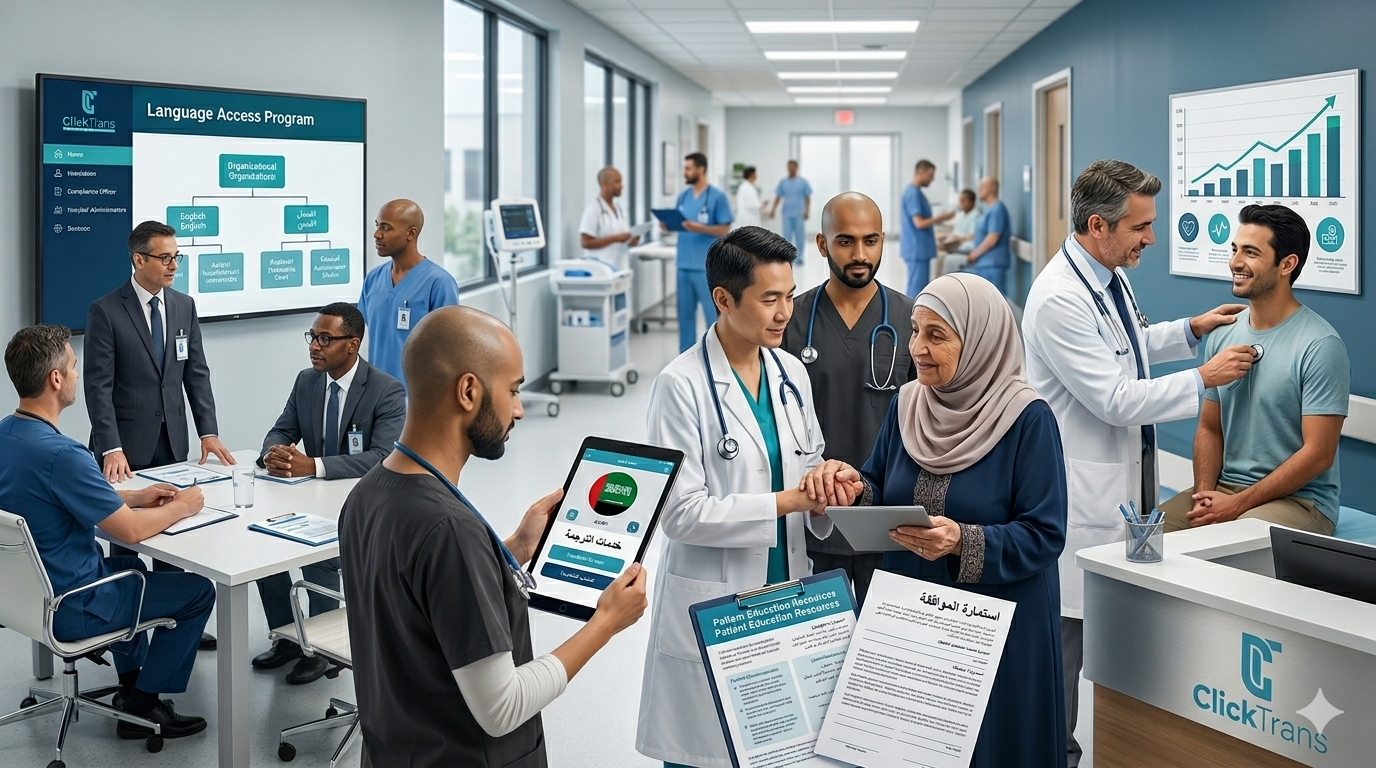
Why Arabic Translation Is Increasingly Important
Arabic-speaking communities continue to grow throughout the United States.
Hospitals, clinics, healthcare systems, and insurance providers increasingly encounter Arabic-speaking patients who may benefit from translated healthcare materials.
Common healthcare documents requiring Arabic translation include:
- Patient intake forms
- Consent forms
- Discharge instructions
- Medical records
- Medication guides
- Insurance documents
- Patient education resources
Providing Arabic-language materials helps healthcare organizations improve accessibility and strengthen communication with Arabic-speaking communities.
Building an Effective Language Access Program
A successful language access strategy requires planning, consistency, and ongoing evaluation.
Key components often include:
Multilingual Documentation
Healthcare organizations should identify frequently used documents and make them available in relevant languages.
Qualified Language Professionals
Professional translators and interpreters help ensure accuracy and consistency.
Staff Training
Healthcare staff should understand when and how to access language support resources.
Technology Integration
Digital healthcare systems, patient portals, and telehealth platforms should support multilingual communication whenever possible.
Continuous Improvement
Organizations should regularly assess language access initiatives and identify opportunities for improvement.
Common Healthcare Documents That Require Translation
Healthcare providers produce a wide variety of patient-facing documents.
Frequently Translated Documents
| Document Type | Purpose |
| Consent Forms | Patient authorization |
| Medical Records | Clinical information |
| Discharge Instructions | Post-treatment guidance |
| Insurance Documents | Coverage details |
| Medication Guides | Drug safety information |
| Patient Education Materials | Health literacy support |
| Appointment Information | Scheduling communication |
| Telehealth Resources | Remote healthcare access |
Professional translation helps ensure these materials remain clear, accurate, and culturally appropriate.
The Role of Language Access in Patient Safety
Patient safety depends on effective communication.
Language barriers may contribute to:
- Medication errors
- Missed follow-up care
- Misunderstood diagnoses
- Delayed treatment
- Incomplete informed consent
Professional translation services help reduce communication-related risks and support safer healthcare experiences.
Communication Challenges and Potential Risks
| Communication Barrier | Potential Impact |
| Misunderstood Instructions | Treatment errors |
| Medication Confusion | Incorrect dosage |
| Incomplete Consent | Reduced understanding |
| Poor Follow-Up Communication | Readmissions |
| Language Barriers | Delayed care |
Reducing communication barriers helps healthcare organizations strengthen patient safety efforts.
Human Translation vs Machine Translation in Healthcare
Machine translation tools have become increasingly accessible, but healthcare communication requires exceptional accuracy.
Medical content often contains:
- Technical terminology
- Context-sensitive language
- Legal disclosures
- Patient-specific information
Human medical translators understand the linguistic, cultural, and medical nuances necessary for accurate communication.
Professional review remains essential when translating healthcare documentation.
Why Healthcare Organizations Choose ClickTrans
Healthcare providers need translation partners that understand both language and medicine.
ClickTrans provides specialized Arabic medical translation services for healthcare organizations across the United States. Our experienced medical linguists help hospitals, clinics, healthcare systems, pharmaceutical companies, and insurance providers communicate effectively with Arabic-speaking patients.
Our services support:
- Medical document translation
- Consent form translation
- Medical record translation
- Patient education materials
- Healthcare websites
- Telehealth content
- Insurance documentation
By combining healthcare expertise with professional linguistic knowledge, ClickTrans helps organizations strengthen language access programs and improve patient communication.
Related Resources
To learn more about Arabic healthcare communication, read:
You may also be interested in:
Why U.S. Hospitals Need Professional Arabic Translation Services for LEP Patients
Arabic Translation for Medical Records, Consent Forms, and Healthcare Documents in the USA
Together, these resources provide a comprehensive overview of language access, healthcare communication, and Arabic medical translation services.
Conclusion
Language access is a fundamental component of patient-centered healthcare. As healthcare organizations continue serving increasingly diverse communities, providing accessible communication becomes more important than ever.
Professional Arabic translation services help healthcare providers improve communication, enhance accessibility, strengthen patient safety initiatives, and support better healthcare experiences for Arabic-speaking patients.
Whether translating consent forms, medical records, discharge instructions, insurance documents, or patient education materials, accurate communication remains essential to quality care.
ClickTrans is proud to support healthcare organizations throughout the United States with professional Arabic medical translation services that help bridge language barriers and improve healthcare communication.