info@clicktranss.com


Table of Contents
Introduction
Effective communication is one of the foundations of quality healthcare. Every day, hospitals across the United States provide care to patients from diverse linguistic and cultural backgrounds. While English remains the primary language used in healthcare settings, millions of patients speak another language at home and may have limited English proficiency (LEP). For these patients, understanding medical information can be challenging, particularly during stressful healthcare situations.
Among the many languages spoken in the United States, Arabic represents an important and growing language group. Arabic-speaking patients seek healthcare services in hospitals, emergency departments, specialty clinics, and outpatient facilities throughout the country. These patients often require access to translated healthcare materials and language support services to fully understand their medical care.
Professional Arabic translation services help hospitals improve communication, enhance patient safety, reduce misunderstandings, and provide a better overall healthcare experience. From admission paperwork and consent forms to discharge instructions and patient education materials, accurate translation plays a critical role throughout the patient journey.
At ClickTrans, we help healthcare organizations communicate effectively with Arabic-speaking patients through specialized Arabic medical translation services designed for hospitals, health systems, and healthcare providers across the United States.
Understanding Limited English Proficiency (LEP) Patients
Limited English Proficiency refers to individuals who do not speak English as their primary language and who may have difficulty reading, writing, speaking, or understanding English.
LEP patients often face significant challenges when navigating healthcare systems. Medical terminology can be complex even for native English speakers. When patients must process diagnoses, treatment recommendations, insurance information, and medication instructions in a second language, the risk of misunderstanding increases dramatically.
Hospitals that serve diverse communities regularly encounter patients who require language assistance to access healthcare information. Providing translated materials helps these patients better understand their care and participate more actively in healthcare decisions.
The Growing Arabic-Speaking Population in the United States
Arabic-speaking communities continue to grow throughout the United States. Large populations can be found in major metropolitan areas, including communities in Michigan, California, Texas, New York, Illinois, and New Jersey.
These communities include:
- Immigrants
- Refugees
- International students
- Business professionals
- Families with Arabic-speaking relatives
Many Arabic-speaking patients prefer receiving healthcare information in Arabic, especially when discussing serious medical conditions, surgical procedures, treatment plans, or medication instructions.
Hospitals that provide Arabic-language resources are better positioned to meet the needs of these communities and improve healthcare accessibility.
Why Communication Is Critical in Hospital Settings
Hospitals are fast-paced environments where communication directly affects patient care.
Healthcare providers must communicate clearly regarding:
- Symptoms
- Diagnoses
- Treatment options
- Surgical procedures
- Medication instructions
- Follow-up care
- Patient rights
When patients do not fully understand this information, healthcare outcomes may suffer.
Clear communication supports:
- Informed decision-making
- Better patient engagement
- Improved treatment adherence
- Reduced confusion
- Greater trust between providers and patients
Professional Arabic translation helps hospitals deliver this information accurately and consistently.
Arabic Translation in Emergency Departments
Emergency departments present unique communication challenges.
Patients often arrive in stressful situations involving pain, anxiety, injury, or medical emergencies. In these situations, rapid communication is essential.
Healthcare providers may need to obtain information regarding:
- Symptoms
- Allergies
- Existing medical conditions
- Current medications
- Previous surgeries
Misunderstandings can delay treatment and create unnecessary risks.
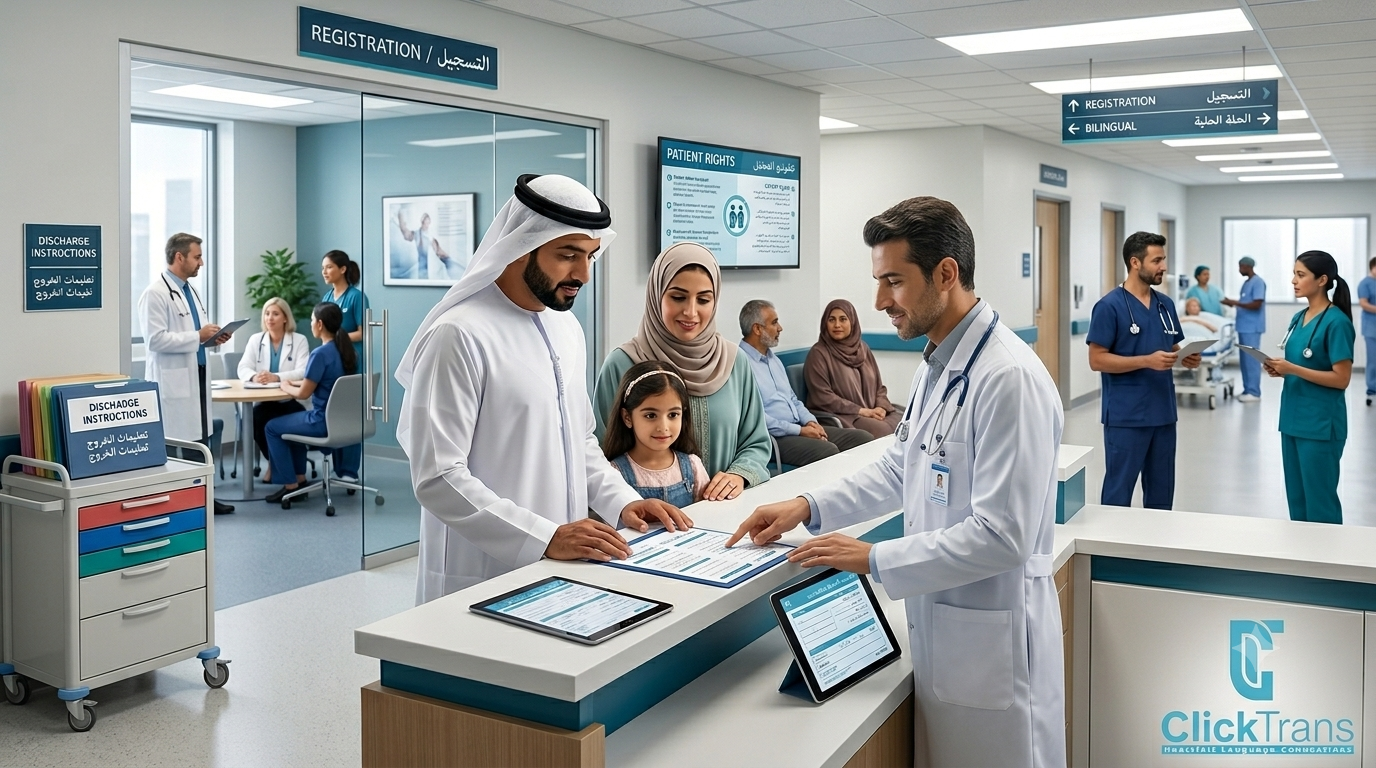
Arabic translation services help hospitals provide translated intake forms, patient information sheets, and discharge instructions that improve communication during emergency care.
Emergency Department Documents Frequently Requiring Translation
| Document Type | Purpose |
| Intake Forms | Patient registration and history |
| Triage Documents | Initial assessment information |
| Consent Forms | Authorization for treatment |
| Discharge Instructions | Post-visit guidance |
| Medication Information | Drug usage and safety details |
The Importance of Accurate Surgical Consent Forms
Informed consent is a critical component of ethical and legal healthcare practice.
Before surgery or medical procedures, patients must understand:
- The purpose of the procedure
- Potential risks
- Expected benefits
- Available alternatives
- Recovery expectations
If a patient cannot fully understand consent documentation, the quality of informed consent may be compromised.
Professional Arabic translation ensures that Arabic-speaking patients receive accurate information that helps them make informed healthcare decisions.
Discharge Instructions and Follow-Up Care
The patient journey does not end when a hospital visit is complete.
Discharge instructions often contain critical information regarding:
- Medication schedules
- Follow-up appointments
- Dietary restrictions
- Activity limitations
- Warning signs requiring medical attention
Patients who do not fully understand discharge instructions may experience complications or require readmission.
Providing professionally translated discharge materials helps patients follow medical recommendations more effectively and supports better recovery outcomes.
Reducing Hospital Readmissions Through Better Communication
Hospital readmissions are a significant concern for healthcare organizations.
Readmissions may occur when patients:
- Misunderstand treatment instructions
- Fail to take medications correctly
- Miss follow-up appointments
- Do not recognize warning signs
Language barriers can contribute to these challenges.
Professional Arabic translation helps improve patient understanding and supports continuity of care after discharge. When patients receive information in their preferred language, they are more likely to follow medical instructions and participate actively in their recovery process.
Arabic Translation for Patient Education Materials
Hospitals frequently provide educational resources to help patients understand health conditions and treatment options.
Examples include:
- Diabetes management guides
- Heart health resources
- Cancer education materials
- Prenatal care information
- Preventive health resources
These materials are most effective when patients can read and understand them comfortably.
Arabic translation helps hospitals make healthcare information more accessible to Arabic-speaking communities while promoting health literacy and patient engagement.
Supporting Patient Safety Through Accurate Translation
Patient safety is one of the most important priorities in healthcare.
Communication errors can contribute to:
- Medication mistakes
- Incorrect treatment decisions
- Missed symptoms
- Delayed care
- Patient confusion
Professional Arabic medical translation helps reduce these risks by ensuring healthcare information remains accurate and understandable.
Common Communication Risks
| Communication Issue | Potential Consequence |
| Medication misunderstanding | Incorrect dosage |
| Incomplete discharge understanding | Readmission |
| Misunderstood diagnosis | Delayed treatment |
| Inaccurate consent information | Patient confusion |
| Missed follow-up instructions | Poor health outcomes |
By improving communication, hospitals can strengthen patient safety initiatives and support better clinical outcomes.
Building Trust with Arabic-Speaking Communities
Trust is an essential component of healthcare.
Patients who feel understood are more likely to:
- Ask questions
- Share important medical information
- Follow treatment plans
- Return for follow-up care
- Recommend healthcare providers to others
Providing professionally translated materials demonstrates respect for patients’ language preferences and cultural backgrounds.
Hospitals that invest in language access often strengthen relationships with diverse communities and improve overall patient satisfaction.
Why Professional Medical Translators Matter
Medical translation requires specialized expertise.
Healthcare terminology includes technical language that demands accuracy and consistency. Generic translation tools or unqualified translators may introduce errors that affect patient understanding.
Professional medical translators offer:
- Medical terminology expertise
- Industry-specific knowledge
- Cultural understanding
- Quality assurance processes
- Consistent terminology management
These factors help ensure translated healthcare materials remain accurate and reliable.
Human Translation vs Machine Translation in Hospitals
Machine translation technology has become increasingly common. However, hospitals should exercise caution when relying on automated tools for medical content.
Healthcare documents often contain:
- Complex terminology
- Legal disclosures
- Sensitive patient information
- Context-dependent language
Human translators provide the expertise necessary to interpret medical concepts accurately and adapt content appropriately for Arabic-speaking audiences.
For critical healthcare communications, professional human translation remains the preferred solution.
Why Hospitals Choose ClickTrans
Healthcare organizations require translation partners that understand the unique demands of medical communication.
ClickTrans provides specialized Arabic medical translation services for hospitals and healthcare systems throughout the United States. Our team combines linguistic expertise with healthcare knowledge to deliver accurate, culturally appropriate translations that support patient care and communication goals.
We assist hospitals with:
- Patient forms
- Consent documentation
- Discharge instructions
- Educational materials
- Medical records
- Healthcare websites
- Digital patient communications
Our commitment to quality helps healthcare organizations communicate effectively with Arabic-speaking patients while supporting accessibility and patient-centered care initiatives.
Related Resource
To learn more about the broader role of language access in healthcare, read our guide:
This article explores how professional Arabic translation supports healthcare providers, clinics, pharmaceutical companies, and medical organizations throughout the United States.
Conclusion
Hospitals serve increasingly diverse patient populations, making effective communication more important than ever. Arabic-speaking patients deserve access to healthcare information they can understand, particularly when making decisions that affect their health and well-being.
Professional Arabic translation services help hospitals improve communication, strengthen patient safety, enhance healthcare accessibility, and build trust within Arabic-speaking communities.
From emergency department forms and surgical consent documents to discharge instructions and patient education materials, accurate translation plays a critical role throughout the healthcare journey.
ClickTrans is proud to support hospitals and healthcare organizations across the United States with professional Arabic medical translation services designed to improve communication, patient engagement, and healthcare outcomes.