info@clicktranss.com


Table of Contents
Artificial intelligence and machine translation tools have transformed the way people translate content. From business documents and marketing materials to legal files and websites, automated translation solutions are now faster and more accessible than ever.
However, speed does not always guarantee accuracy.
When it comes to Spanish translation, relying entirely on AI-generated content without professional review can lead to serious linguistic, cultural, and contextual errors. This is why Spanish proofreading, Spanish editing, and Spanish post editing services have become essential for businesses and individuals who want high-quality communication.
While machine translation can provide a useful starting point, human review remains critical to ensure that translated Spanish content sounds natural, accurate, and culturally appropriate.
The Growing Use of AI in Spanish Translation
AI translation tools are increasingly used for translating Spanish documents because they save time and reduce initial translation costs.
Businesses frequently use machine translation for website localization, customer communication, marketing materials, contracts, and multilingual content production. Although these tools can process large volumes of text quickly, they still struggle with grammar nuances, idiomatic expressions, regional terminology, and cultural context.
Spanish is one of the most linguistically diverse languages in the world, spoken across Spain, Latin America, and the United States. Small wording differences can completely change meaning depending on the audience being targeted.
This is where Spanish proofreading and Spanish post editing become essential.
What Is Spanish Proofreading?
Spanish proofreading is the process of reviewing translated Spanish content to identify and correct grammar mistakes, spelling issues, punctuation errors, and readability problems.
The goal is not simply to remove mistakes, but to ensure the translated content sounds fluent and natural to native Spanish speakers.
Professional proofreaders also review tone, consistency, sentence flow, and localization accuracy to make sure the final content matches the intended audience and purpose.
This process is especially important for professional, legal, medical, and business-related content where accuracy directly affects credibility.
The Difference Between Spanish Editing and Spanish Post Editing
Although they are closely related, Spanish editing and Spanish post editing are not exactly the same.
Spanish editing focuses on improving the overall writing quality, clarity, structure, and tone of translated content. Editors may rewrite awkward sentences and improve readability to create more polished communication.
Spanish post editing specifically involves reviewing machine-translated content generated by AI tools and correcting the errors produced by automated systems.
Today, many businesses combine AI translation with professional human post editing to improve efficiency while maintaining quality standards.
Why AI Translations Often Fail in Spanish
Despite significant improvements in machine translation technology, AI tools still struggle with several core aspects of the Spanish language.
One major issue is regional variation. Spanish spoken in Mexico differs from the Spanish used in Spain, Argentina, Colombia, or the United States. Vocabulary, tone, and expressions can vary dramatically between countries.
AI tools also struggle with context and cultural meaning. Literal translations may sound grammatically correct but still feel unnatural or confusing to native readers.
Spanish grammar itself presents another challenge. Gender agreement, verb conjugations, sentence structure, and formal versus informal communication are areas where automated systems frequently make mistakes.
Cultural localization is equally important. Marketing slogans, emotional messaging, and conversational language often lose their intended impact when translated entirely by machines.
Because of these limitations, professional Spanish proofreading remains a critical step after AI translation.
Comparison Table: AI Translation vs Human Spanish Proofreading
| Feature | AI / Machine Translation | Human Spanish Proofreading & Editing |
| Grammar Accuracy | Often inconsistent with complex Spanish grammar | Reviewed and corrected by native linguists |
| Cultural Localization | Limited understanding of regional nuances | Adapted for target Spanish-speaking audience |
| Tone & Readability | Can sound robotic or unnatural | Natural, fluent, and audience-friendly |
| SEO Optimization | Weak keyword placement and repetition | Improved keyword flow and readability |
| Context Understanding | Literal interpretation of sentences | Context-aware and culturally accurate |
| Regional Spanish Variations | Frequently ignores dialect differences | Adjusted for Spain, Latin America, or U.S. Spanish |
| Marketing Effectiveness | Lower engagement and emotional impact | Stronger communication and audience trust |
| Professional Quality | Requires manual correction | Ready for business and professional use |
| Risk of Errors | Higher risk in legal or medical content | Human-reviewed for accuracy and clarity |
| Final User Experience | May reduce credibility | Builds trust and professionalism |
Industries That Require Spanish Post Editing
Some industries simply cannot afford translation mistakes because errors may affect trust, legal compliance, or customer understanding.
Legal documents, healthcare content, immigration paperwork, financial communication, and multilingual marketing campaigns all require high levels of linguistic precision.
In these sectors, even small translation errors can create misunderstandings, delays, or reputational damage.
Professional Spanish editing helps ensure that translated content remains accurate, culturally appropriate, and professionally written.
Human Proofreading Improves SEO Performance
Poorly translated Spanish content can negatively affect search engine rankings and user engagement.
Search engines increasingly prioritize content quality, readability, and localization relevance. AI-generated translations often contain unnatural phrasing, repetitive wording, and awkward keyword placement that reduce overall content quality.
Professional Spanish proofreading improves readability, keyword integration, and user experience while helping businesses create content that feels authentic for Spanish-speaking audiences.
For companies targeting multilingual SEO growth, high-quality Spanish editing plays a major role in improving visibility and engagement.
The Importance of Native Spanish Linguists
One of the biggest advantages of professional Spanish proofreading is the involvement of native Spanish linguists who understand regional communication styles and cultural expectations.
Native reviewers can identify subtle problems that AI tools usually miss, including unnatural phrasing, incorrect tone, localization issues, and cultural inconsistencies.
This human expertise ensures that translated Spanish content feels natural and trustworthy rather than obviously machine-generated.
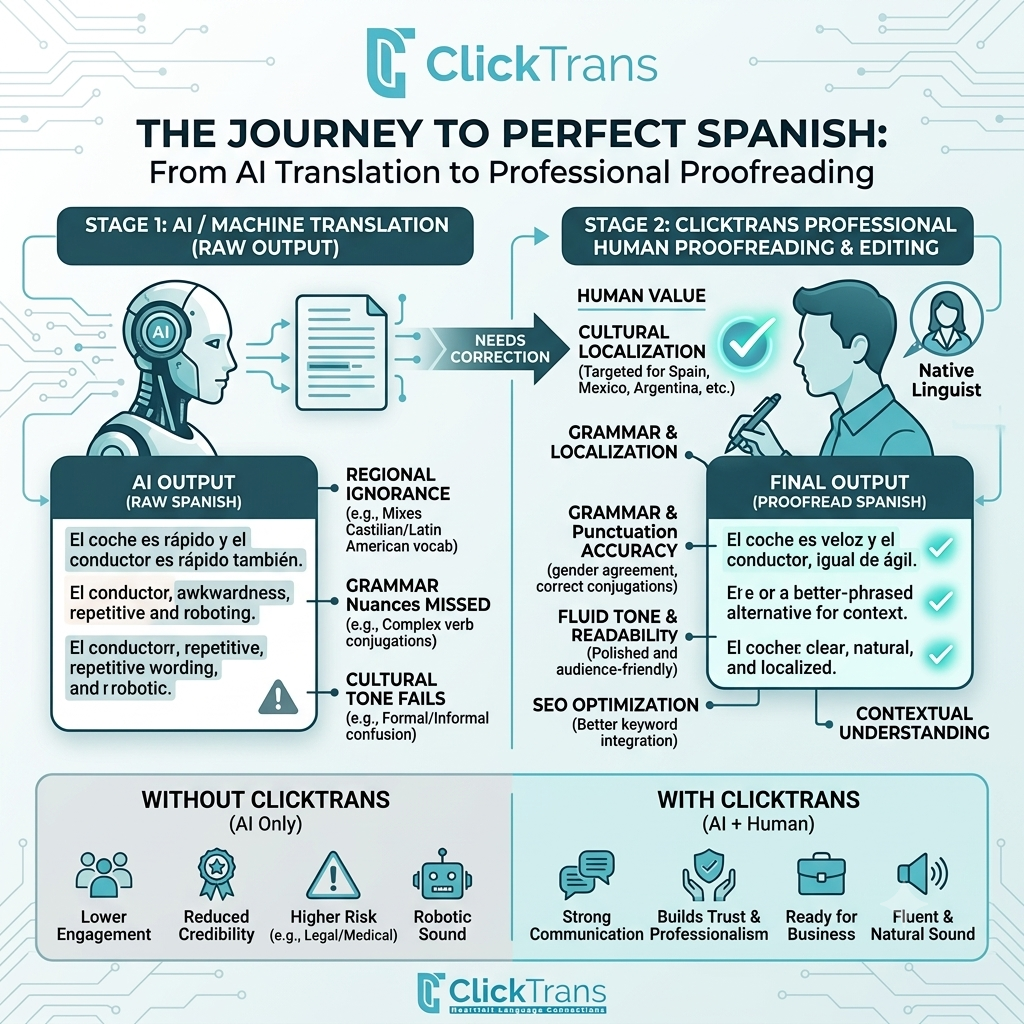
Important Visual Insight: AI Translation vs Human Spanish Proofreading
One of the most effective ways to demonstrate the importance of Spanish proofreading is by visually comparing raw AI-generated translations with professionally edited Spanish content.
For example, an AI-translated marketing sentence may appear grammatically correct but still sound unnatural or culturally inaccurate to native Spanish speakers. A professionally proofread version improves tone, readability, localization, and audience engagement.
The visual comparison could also highlight:
- Grammar correction examples
- Regional Spanish vocabulary differences
- SEO improvements after Spanish editing
- Human localization versus machine-generated wording
This section is ideal for generating a professional infographic or AI-designed visual explaining the transformation from machine translation to human-edited Spanish content.
Why Businesses Choose Professional Spanish Proofreading Services
Businesses investing in multilingual communication understand that translation quality directly affects brand reputation and customer trust.
Professional Spanish proofreading and post-editing services help companies improve communication accuracy, strengthen multilingual SEO performance, and avoid embarrassing translation mistakes.
At ClickTrans, we specialize in Spanish translation, Spanish proofreading, Spanish editing, and Spanish post editing services designed to improve accuracy, readability, and localization quality. Our language experts carefully review AI-generated Spanish translations to ensure they meet professional linguistic and cultural standards.
Final Thoughts
AI translation technology continues to evolve, but human expertise remains essential for producing accurate and natural Spanish content.
Machine translation can accelerate workflows, but without professional Spanish proofreading and editing, translated content may still contain errors that affect credibility, clarity, and audience engagement.
Combining AI efficiency with expert human review provides the best balance between speed, quality, and localization accuracy.
If you need professional Spanish translation, Spanish proofreading, or Spanish post editing services, ClickTrans provides reliable language solutions tailored for businesses and individuals who value accuracy and high-quality multilingual communication.
Frequently Asked Questions
What is Spanish post editing?
Spanish post editing is the process of reviewing and correcting machine-translated Spanish content to improve grammar, readability, accuracy, and cultural relevance.
Why is Spanish proofreading important after AI translation?
AI translation tools often produce grammar, context, and localization mistakes. Professional proofreading ensures the content sounds natural and accurate for native Spanish speakers.
What is the difference between Spanish proofreading and Spanish editing?
Spanish proofreading focuses mainly on correcting errors, while Spanish editing also improves writing style, clarity, structure, and overall readability.