info@clicktranss.com


Table of Contents
The United States is one of the most linguistically diverse countries in the world. Millions of people living in the U.S. speak languages other than English at home, creating a healthcare environment where accurate multilingual communication is no longer optional — it is essential.
According to U.S. Census data, more than 67 million Americans speak a language other than English in their daily lives. Spanish remains the most widely spoken non-English language, followed by Chinese, Arabic, Tagalog, Vietnamese, and French. In hospitals, clinics, pharmacies, and healthcare institutions across the country, this linguistic diversity creates both opportunities and challenges for healthcare providers.
For patients with limited English proficiency (LEP), language barriers can directly affect diagnosis accuracy, treatment understanding, medication safety, and overall healthcare outcomes. This is why professional medical translation services play a critical role in modern American healthcare systems.
As healthcare becomes increasingly global and multicultural, providers must ensure that every patient receives clear, accurate, and culturally appropriate medical communication regardless of their native language.
The Growing Need for Medical Translation in the USA
Healthcare providers across the United States serve patients from diverse ethnic, cultural, and linguistic backgrounds. In many cities, multilingual communities represent a significant percentage of the population, making healthcare translation services a necessity rather than a convenience.
Medical communication involves highly sensitive and technical information. Even small misunderstandings can lead to serious consequences, including incorrect treatment, delayed diagnosis, medication misuse, or patient safety risks.
Professional medical translation helps bridge communication gaps in situations such as:
- Patient intake forms
- Consent documentation
- Prescription instructions
- Medical records
- Clinical reports
- Insurance and billing documents
Healthcare organizations increasingly rely on specialized language services to improve patient care, maintain compliance, and reduce communication-related risks.
For healthcare institutions seeking reliable multilingual support, medical translation services have become an essential component of patient-centered care.
Why Accurate Medical Translation Saves Lives
Unlike general translation, medical translation requires deep linguistic precision and healthcare expertise. Translators must understand medical terminology, healthcare systems, anatomy, pharmaceutical language, and cultural communication practices.
Inaccurate translations in healthcare settings can create dangerous misunderstandings. A mistranslated dosage instruction, allergy note, or consent form may directly affect patient safety.
Professional healthcare translation services help providers:
- Improve communication accuracy
- Reduce medical misunderstandings
- Increase patient trust and satisfaction
- Support multilingual healthcare access
- Improve healthcare inclusivity
In hospitals and emergency care environments, fast and accurate communication can significantly impact treatment outcomes.
This growing demand has also increased the importance of language translation services for healthcare and translation services for medical providers across the United States.
The Most Requested Medical Translation Services
Healthcare organizations require different types of translation depending on the medical field, patient needs, and documentation requirements.
Some of the most requested services include medical records translation, clinical documentation translation, pharmaceutical translation, insurance paperwork translation, and multilingual patient communication.
Specialized medical sectors also require expert support. For example, medical device translation services are critical for manufacturers, healthcare distributors, and international compliance processes.
Patient documentation also remains one of the largest areas of demand. Accurate medical records translation services help patients, physicians, and healthcare institutions securely exchange important medical information across languages.
As healthcare systems become more digitally connected, the demand for multilingual medical communication continues to grow rapidly.
Comparison Table: Professional Medical Translation vs General Translation
| Feature | General Translation | Professional Medical Translation |
| Medical Terminology Knowledge | Limited | Specialized healthcare expertise |
| Patient Safety Accuracy | Moderate risk of errors | High linguistic precision |
| Regulatory Compliance | Not guaranteed | HIPAA-aware processes |
| Healthcare Context Understanding | Basic | Advanced medical knowledge |
| Cultural Healthcare Sensitivity | Limited | Professionally localized |
| Suitable for Medical Records | Not recommended | Highly suitable |
| Pharmaceutical Translation Accuracy | Inconsistent | Professionally reviewed |
| Risk of Miscommunication | Higher | Significantly reduced |
This comparison highlights why healthcare organizations should work with experienced medical translation professionals instead of relying on general translation solutions or automated tools.
HIPAA Compliance and Patient Privacy
Patient confidentiality is one of the most critical aspects of healthcare communication in the United States.
Healthcare providers handling multilingual patient data must ensure that all translation processes follow strict privacy and security standards. This is especially important when translating medical histories, insurance information, laboratory results, and personal healthcare records.
HIPAA compliant medical translation services help healthcare organizations protect sensitive patient information while maintaining accurate multilingual communication.
Secure medical translation workflows reduce compliance risks and strengthen patient trust in healthcare institutions.
The Growing Demand for Spanish and Arabic Medical Translation
Spanish-speaking populations represent one of the largest healthcare language groups in the United States. Many hospitals, clinics, and healthcare providers now prioritize English to Spanish medical translation to improve communication with Hispanic communities.
At the same time, Arabic-speaking communities across the U.S. have also increased demand for specialized Arabic medical translation services, particularly in metropolitan healthcare systems and immigration-related healthcare services.
Medical translation is not simply about converting words between languages. It also requires cultural understanding, regional language adaptation, and awareness of healthcare communication expectations within different communities.
Providing multilingual healthcare communication improves patient engagement and helps create more inclusive healthcare experiences.
The Cost of Poor Medical Translation
Poor medical translation can create significant operational and legal risks for healthcare providers.
Translation errors may lead to treatment misunderstandings, incorrect medication usage, delayed procedures, patient dissatisfaction, or even legal disputes. In some cases, communication failures can increase hospital readmission rates and negatively affect healthcare outcomes.
Professional medical translation services cost varies depending on document complexity, language pair, turnaround time, and technical specialization. However, investing in accurate healthcare translation is significantly less costly than the risks associated with medical communication errors.
As healthcare systems continue expanding multilingual support, professional translation has become a long-term investment in patient safety and operational quality.
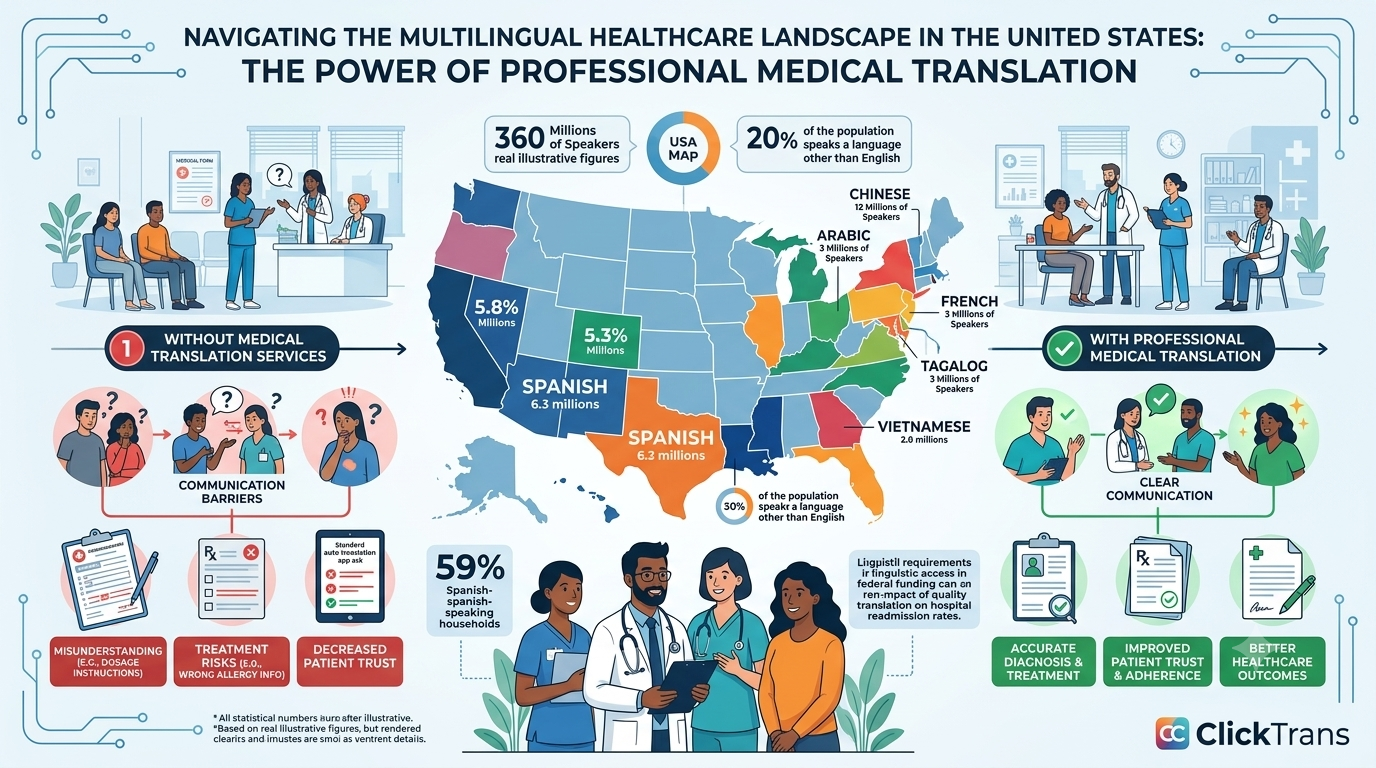
Important Visual Insight: The Multilingual Healthcare Landscape in the USA
One of the most valuable ways to visualize the importance of medical translation in the United States is through a healthcare language diversity infographic.
The visual could display the percentage of Americans who speak languages other than English, the most common non-English languages used in healthcare settings, and the communication challenges faced by patients with limited English proficiency.
The infographic could also include visual comparisons showing how professional medical translation improves patient understanding, healthcare accessibility, treatment accuracy, and communication efficiency across multilingual communities.
A high-quality visual map showing Spanish-speaking, Arabic-speaking, Chinese-speaking, and multilingual population distribution across major U.S. regions would make this information highly engaging and educational for readers while reinforcing the importance of professional healthcare translation services.
Choosing the Right Medical Translation Partner
Healthcare providers must work with experienced medical translation companies () and trusted medical translation agencies that understand both healthcare terminology and regulatory standards.
The right translation partner should provide:
- Native medical linguists
- Healthcare subject matter expertise
- Confidential translation workflows
- Fast turnaround times
- Multilingual localization support
Healthcare organizations searching for medical translation services near me increasingly prioritize providers that combine linguistic accuracy with healthcare specialization.
Why ClickTrans Medical Translation Services
At ClickTrans, we specialize in professional medical translation services designed to support healthcare providers, clinics, hospitals, insurance companies, and multilingual patients across the United States.
Our expert medical linguists provide accurate, culturally adapted, and HIPAA-aware translation solutions tailored for healthcare communication. From medical records and patient documentation to healthcare localization and multilingual patient support, ClickTrans helps organizations improve communication quality while protecting patient trust and safety.
Whether you require Spanish, Arabic, or multilingual healthcare translation support, ClickTrans delivers reliable language solutions designed for the modern American healthcare environment.
Frequently Asked Questions
Why are medical translation services important in the USA?
Medical translation services help healthcare providers communicate accurately with multilingual patients, improving safety, understanding, and healthcare accessibility.
What languages are most requested in healthcare translation?
Spanish, Arabic, Chinese, Vietnamese, and Tagalog are among the most requested languages in U.S. healthcare translation services.
What makes medical translation different from general translation?
Medical translation requires specialized knowledge of healthcare terminology, patient communication, medical documentation, and regulatory compliance standards.