info@clicktranss.com


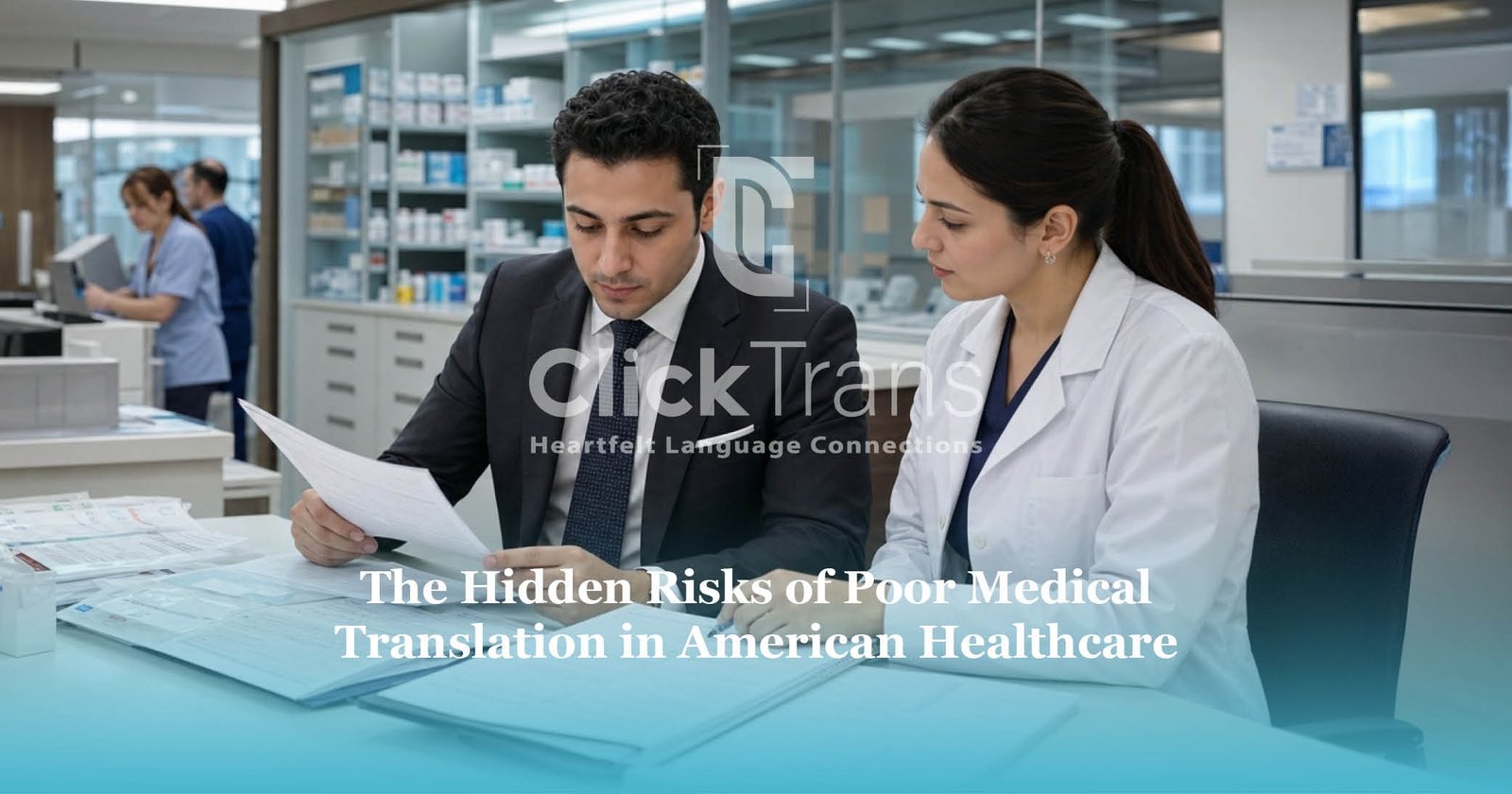
Table of Contents
Healthcare communication can directly affect patient safety, treatment outcomes, and medical decision-making. In a country as linguistically diverse as the United States, accurate multilingual communication is no longer optional for healthcare providers — it is a critical component of safe and effective patient care.
Millions of Americans speak languages other than English at home, and many patients experience limited English proficiency when interacting with hospitals, clinics, pharmacies, and healthcare institutions. In these situations, even small healthcare translation mistakes can create serious medical, legal, and operational consequences.
From misunderstood prescriptions to inaccurate medical records, poor medical translation can place both patients and healthcare providers at significant risk.
As healthcare systems continue serving multicultural communities across the United States, professional medical translation services have become essential for reducing communication barriers and improving patient safety.
Why Medical Translation Accuracy Matters
Medical translation differs significantly from general translation because healthcare communication contains complex terminology, sensitive patient information, and life-critical instructions.
A single mistranslated phrase can affect diagnosis accuracy, medication usage, treatment procedures, or emergency care decisions. In high-pressure healthcare environments, communication errors may lead to delayed treatment, patient confusion, or preventable medical complications.
Professional medical translation services help healthcare organizations maintain communication accuracy while improving healthcare accessibility for multilingual patients.
Accurate translation is especially important for patient intake forms, discharge instructions, surgical consent documents, prescription information, insurance paperwork, and laboratory reports.
Healthcare providers increasingly recognize that multilingual communication is directly connected to healthcare quality and patient trust.
Common Medical Translation Errors in Healthcare
Medical translation errors can occur in multiple forms, particularly when healthcare organizations rely on unqualified translators, automated systems, or literal machine translation tools.
One common issue involves incorrect medical terminology. Many healthcare terms have highly specific meanings that cannot be translated word-for-word without losing accuracy.
Another major problem involves cultural misunderstanding. Certain phrases, symptoms, or patient explanations may carry different meanings depending on cultural and linguistic context.
Healthcare translation mistakes also frequently appear in:
- Medication dosage instructions
- Allergy and medical history documentation
- Surgical consent forms
- Emergency care communication
- Insurance and billing records
Inaccurate translations in these areas may increase patient safety risks and create operational complications for healthcare providers.
The Impact of Poor Translation on Patient Safety
Patient safety remains one of the most serious concerns associated with healthcare translation mistakes.
When patients cannot fully understand diagnoses, prescriptions, treatment plans, or medical procedures, the risk of medical errors increases significantly. Miscommunication may lead to incorrect medication usage, missed appointments, delayed treatment, or misunderstanding of critical health conditions.
For patients with limited English proficiency, language barriers can also reduce confidence in healthcare providers and discourage future medical visits.
Professional language translation services for healthcare help improve communication clarity while supporting safer healthcare experiences for multilingual populations.
Hospitals and healthcare organizations that invest in professional translation services often experience stronger patient satisfaction, better communication outcomes, and improved healthcare accessibility.
Why HIPAA Compliance Is Essential in Medical Translation
Medical translation does not only involve language accuracy — it also involves patient privacy and data protection.
Healthcare organizations handling multilingual patient information must comply with strict confidentiality regulations, particularly when translating medical histories, diagnostic reports, and healthcare records.
HIPAA compliant medical translation services help providers maintain secure translation workflows while protecting sensitive patient data.
Without proper privacy safeguards, healthcare providers may face legal risks, compliance violations, and damage to patient trust.
Professional medical translators understand the importance of confidentiality, secure document handling, and healthcare compliance standards throughout the translation process.
Medical Records Translation Risks
Medical records contain highly detailed patient information that must remain accurate across every stage of healthcare communication.
Errors in translated medical records may create confusion between healthcare providers, affect treatment continuity, or lead to incorrect medical decisions.
Professional medical records translation services help ensure that patient histories, diagnoses, laboratory reports, imaging results, and treatment documentation remain linguistically accurate and medically consistent.
This is especially important for international patients, immigration-related healthcare documentation, second medical opinions, and multilingual healthcare coordination.
Accurate medical records translation improves both healthcare efficiency and patient safety.
Comparison Table: Poor Medical Translation vs Professional Medical Translation
| Area | Poor Medical Translation | Professional Medical Translation |
| Medical Terminology | Inconsistent or incorrect | Accurate healthcare terminology |
| Patient Understanding | Confusing instructions | Clear multilingual communication |
| HIPAA Compliance | Increased privacy risks | Secure confidential workflows |
| Medication Instructions | Risk of dosage misunderstanding | Professionally reviewed accuracy |
| Patient Safety | Higher medical error risk | Improved healthcare outcomes |
| Cultural Localization | Limited cultural awareness | Adapted for patient understanding |
| Healthcare Provider Efficiency | Communication delays | Better workflow support |
| Legal & Compliance Risk | Increased exposure | Reduced operational risk |
This comparison demonstrates why healthcare organizations should avoid relying solely on automated translation systems or non-specialized translators for medical communication.
The Risks of AI and Machine Translation in Healthcare
Artificial intelligence and machine translation tools continue to grow in popularity across many industries, including healthcare. While these technologies can assist with basic multilingual communication, they still present serious limitations in medical environments.
Machine translation systems often fail to understand medical context, regional language nuances, abbreviations, or culturally sensitive healthcare communication. Literal translation output may appear grammatically correct while still creating dangerous misunderstandings for patients.
Healthcare providers should never rely entirely on AI-generated medical translation without professional human review.
Experienced medical linguists play a critical role in reviewing terminology accuracy, patient readability, and contextual meaning to ensure safe healthcare communication.
How Medical Translation Errors Affect Patient Safety
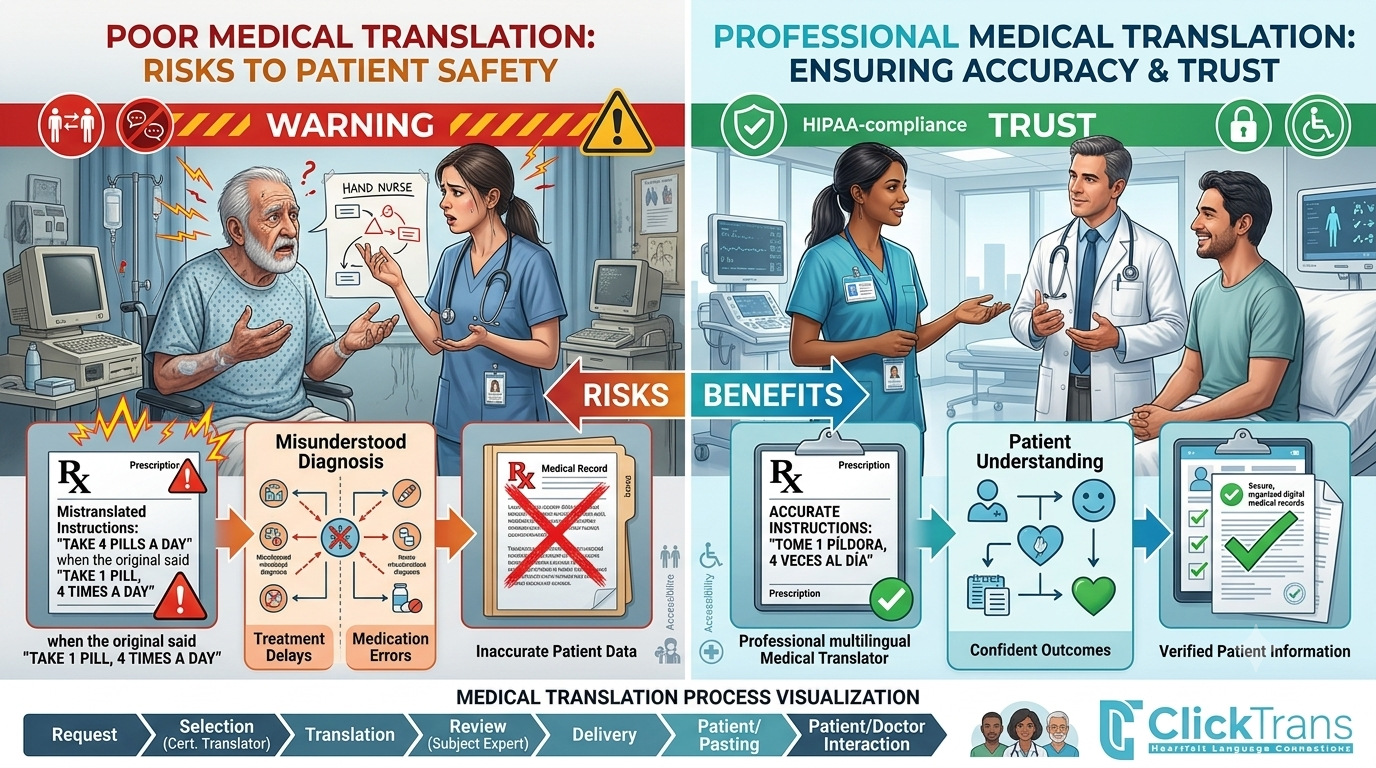
One powerful way to visualize the risks of poor medical translation is through a healthcare communication workflow infographic.
The visual could compare two patient journeys inside a hospital environment:
- One scenario showing poor translation leading to confusion, incorrect medication usage, delayed treatment, and patient frustration
- Another scenario showing professional medical translation improving diagnosis understanding, patient trust, treatment accuracy, and healthcare accessibility
The infographic could also include healthcare communication flowcharts, multilingual patient interactions, HIPAA privacy elements, medical records translation examples, and patient safety indicators.
This type of visual would clearly demonstrate how accurate healthcare translation directly improves patient outcomes while reducing medical interpretation risks.
Why Healthcare Providers Need Professional Translation Support
Healthcare organizations serving multilingual communities require more than basic language conversion. They need specialized medical translation support that combines linguistic accuracy, cultural understanding, healthcare expertise, and regulatory awareness.
Professional translation services for medical providers help healthcare institutions improve patient communication, reduce risk exposure, and maintain higher standards of multilingual care.
At ClickTrans, we specialize in professional medical translation solutions tailored for healthcare providers, clinics, hospitals, and multilingual healthcare systems across the United States.
Our medical linguists understand healthcare terminology, HIPAA-sensitive workflows, and culturally adapted communication practices designed to support patient safety and healthcare accessibility.
Final Thoughts
Poor medical translation can create serious risks for patients, healthcare providers, and healthcare organizations.
Inaccurate communication may affect treatment decisions, medication safety, healthcare compliance, and overall patient trust. As the United States continues serving increasingly multilingual populations, professional medical translation services have become a critical part of modern healthcare operations.
By investing in accurate healthcare translation, providers can improve patient safety, strengthen communication quality, and create more inclusive healthcare experiences for diverse communities.
Frequently Asked Questions
Why are medical translation errors dangerous?
Medical translation errors can lead to incorrect treatment instructions, medication misunderstandings, delayed care, and patient safety risks.
What is HIPAA compliant medical translation?
HIPAA compliant medical translation involves secure and confidential translation processes that protect sensitive patient healthcare information.
Can AI translation tools be used for healthcare translation?
AI tools may assist with basic communication, but professional human medical translators are still necessary to ensure accuracy, safety, and compliance in healthcare environments.