info@clicktranss.com



Table of Contents
Clinical trials involve complex medical information that must be communicated accurately across languages. From informed consent forms to patient information sheets and clinical study protocols, every translated document must preserve the original meaning and use appropriate medical terminology.
Understanding Medical Translation Requirements helps pharmaceutical companies, clinical research organizations, and healthcare professionals prepare documents for international studies while supporting patient safety, regulatory compliance, and clear communication.
Why Is Medical Translation Important in Clinical Trials?
Clinical trials often involve participants, researchers, and healthcare professionals who speak different languages. Accurate translation helps ensure that everyone involved can understand the information relevant to the study.
Poorly translated documents may cause confusion about study procedures, potential risks, eligibility criteria, or medication instructions. These issues can affect informed decision-making and the reliability of communication between research teams and participants.
Professional medical translation supports several important objectives:
- Helping participants understand the purpose and procedures of a clinical trial.
- Communicating potential risks, benefits, and side effects clearly.
- Maintaining consistency in medical terminology across study documents.
- Supporting the review of documents by ethics committees and regulatory authorities.
- Improving communication between international research teams.
The specific Medical Translation Requirements for a study depend on its location, design, target population, and applicable regulatory framework. Translation should therefore be planned as part of the clinical trial documentation process rather than treated as a final administrative step.
Read More: Certified translation for pharmaceutical companies
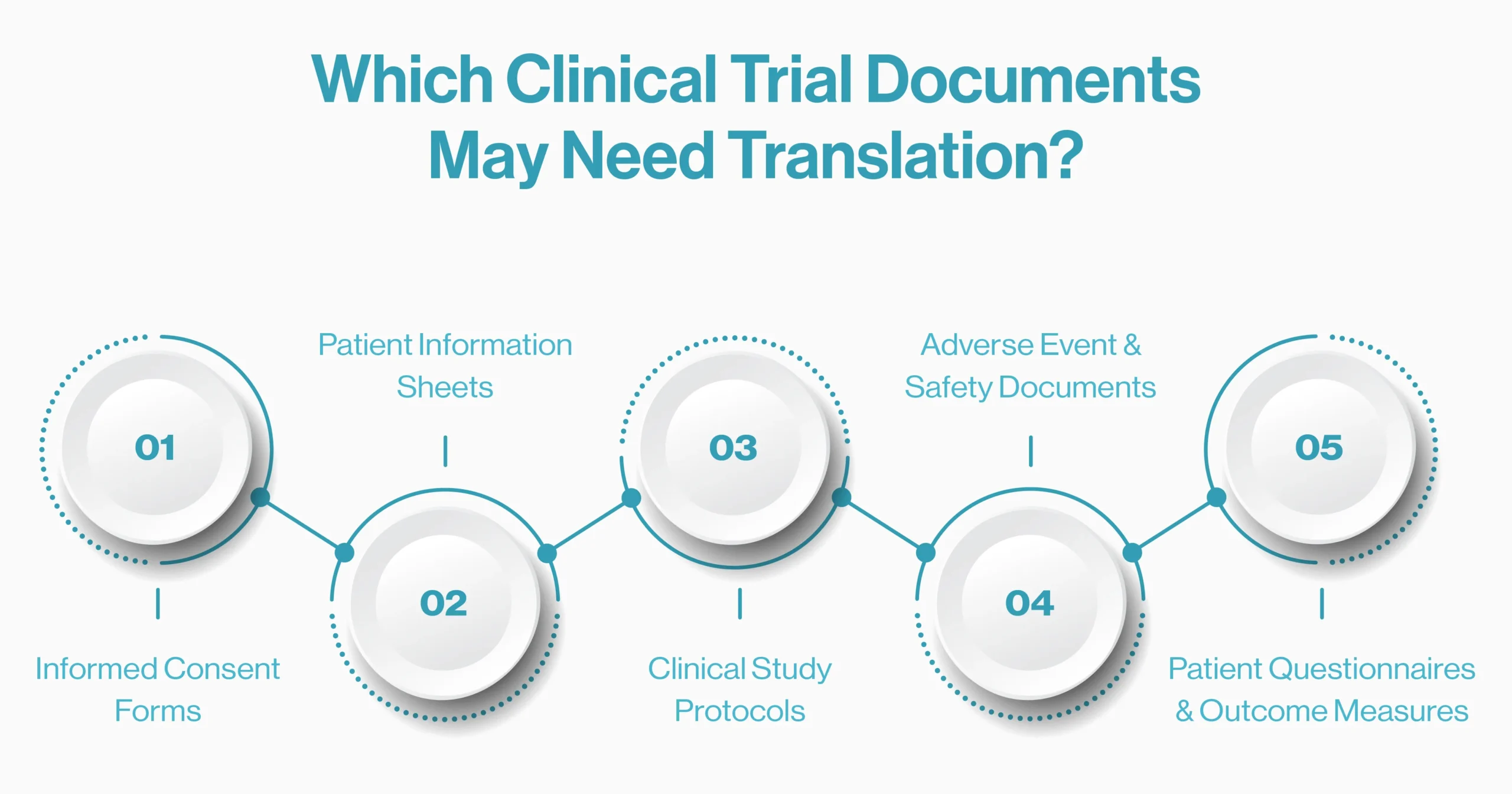
Which Documents Require Translation in Clinical Trials?
Clinical research involves different types of documents, and each serves a specific purpose. The documents requiring translation depend on the study, the languages spoken by participants, and the requirements of the relevant authorities and ethics committees.
1. Informed Consent Forms
Informed consent forms explain the study’s purpose, procedures, potential risks, expected benefits, and participants’ rights.
When participants speak a language different from the original document, a suitable translated version may be necessary to support informed decision-making.
The translation should use clear, understandable language while preserving the meaning of the original content. Technical terminology should be explained appropriately when needed, without changing the study information.
Informed consent forms may also require review or approval by an ethics committee or institutional review board before they are used. The applicable process depends on the study and jurisdiction.
2. Patient Information Sheets
Patient information sheets provide additional details about a clinical study, including what participation involves and whom participants can contact with questions.
These documents should be translated in a way that reflects the intended audience’s language and reading level.
A literal translation may not always communicate medical information effectively. Professional translators must preserve the original meaning while ensuring that the wording is understandable to the intended participants.
3. Clinical Study Protocols
A clinical study protocol describes the objectives, methodology, design, and procedures of a research study.
Protocols contain specialized terminology related to eligibility criteria, dosage, treatment schedules, endpoints, and statistical methods.
Translation may be required when study teams, investigators, or relevant reviewers need to work with documentation in another language. Because these documents are technically complex, translators should have appropriate medical or clinical research expertise.
4. Adverse Event Reports and Safety Documents
Clinical trials require careful documentation of adverse events and other safety-related information.
When these documents need to be translated, the terminology, dates, dosage information, and descriptions of events must remain accurate and consistent with the original records.
The translation process should not introduce interpretations that are absent from the source document. Any unclear or inconsistent information should be referred to the appropriate project contact rather than corrected through guesswork.
5. Questionnaires and Patient-Reported Outcome Measures
Some clinical studies use questionnaires to evaluate symptoms, quality of life, treatment experiences, or other patient-reported outcomes.
Translating these instruments requires particular care because differences in wording may affect how participants understand questions and respond to them.
Depending on the instrument and study protocol, the process may require a formal linguistic validation methodology rather than translation and proofreading alone.
What Are the Main Medical Translation Requirements for Clinical Trials?
Clinical research documents must communicate medical information accurately and consistently. However, the precise requirements vary according to the applicable regulations, study procedures, and document type.
The following principles are important when planning clinical trial translations.
1. Accurate Medical Terminology
Medical terminology must be translated consistently and appropriately for the target language.
Terms related to diagnoses, treatment procedures, medications, laboratory tests, and adverse events should retain their intended meaning throughout the documentation.
Translators should understand the relevant medical subject area and consult approved terminology resources when necessary.
For complex projects, a terminology glossary can help maintain consistency across multiple documents and languages.
2. Qualified Medical Translators
Clinical trial documents often require specialized knowledge beyond general language proficiency.
A qualified medical translator should understand the relevant terminology, recognize ambiguities in the source material, and communicate complex information accurately.
Depending on the project, the translation team may include medical translators, specialist reviewers, and clinical or regulatory experts.
The required qualifications should be assessed according to the document type and applicable project requirements. A general translation certificate alone does not automatically demonstrate expertise in every medical specialty.
3. Quality Assurance and Review
Quality assurance helps identify translation errors, inconsistent terminology, missing content, and formatting problems.
A suitable review process may include:
- Checking the translation against the original document.
- Verifying medical terminology and abbreviations.
- Reviewing numbers, dates, units, and dosage information.
- Checking tables, headings, and document structure.
- Confirming that the translated document is complete.
- Resolving questions about ambiguous source text.
The level of review should reflect the document’s complexity and intended use.
For participant-facing materials, additional review may be appropriate to ensure that the information is understandable to the intended audience.
4. Cultural and Linguistic Appropriateness
Clinical trial materials must communicate clearly to their intended readers.
Certain expressions, medical concepts, or examples may not be understood in the same way across different cultures. Translators must therefore preserve the original meaning while using language appropriate for the target audience.
This does not mean changing the scientific content or removing information about risks. Instead, the goal is to communicate the approved information clearly without altering its substance.
For questionnaires and patient-reported outcome measures, additional cultural adaptation and validation may be necessary under the study’s methodology.
5. Confidentiality and Data Protection
Clinical research documents may contain personal information, health records, or confidential study details.
Translation providers should have appropriate procedures for protecting documents, controlling access, and handling sensitive information.
Before sharing files, research organizations should review the provider’s confidentiality arrangements and determine whether contractual, institutional, or legal data protection requirements apply.
Where necessary, personal identifiers should be minimized or removed in accordance with the study’s approved procedures and applicable law.
Do Clinical Trial Translations Need Certification?
Certification requirements depend on the receiving authority, ethics committee, institution, and type of document.
Some organizations may request a certified translation or a formal statement confirming the accuracy of the translation. Others may require a specific review, approval, or documentation process without requiring certification for every translated file.
It is important to distinguish translation certification from regulatory approval. A certified translation does not, by itself, mean that a clinical trial document has been approved by a regulator or ethics committee.
Before commissioning a translation, confirm:
- Whether certification is explicitly required.
- Whether the translation must follow a particular format.
- Whether the receiving organization requires translator credentials or a signed statement.
- Whether additional notarization or authentication is necessary.
- Whether the document requires review or approval before use in the study.
These checks help prevent unnecessary expenses and reduce the risk of submitting documents that do not meet the recipient’s requirements.
How Do Regulatory Requirements Affect Clinical Trial Translation?
Clinical trials may be subject to different regulations depending on where they are conducted and which authorities oversee them.
In the United States, requirements may involve the Food and Drug Administration (FDA), institutional review boards, and applicable informed consent regulations. In the European Union, relevant requirements may involve the Clinical Trials Regulation and the applicable ethics review processes.
The necessary language versions and review procedures can differ according to the study, the participating population, and the documents being submitted.
For this reason, Medical Translation Requirements should be assessed against the current rules and instructions applicable to the specific trial.
Research organizations should confirm the following before starting translation:
- The countries and jurisdictions involved in the study.
- The documents that must be available in each language.
- The requirements of the relevant ethics committees and regulatory authorities.
- Whether linguistic validation or independent review is necessary.
- The approval process for translated participant-facing materials.
- Any required records documenting translation and review.
Consulting the relevant regulatory guidance and ethics committee instructions is essential because requirements can change and may differ between studies.
What Is the Difference Between Medical Translation and Clinical Trial Translation?
Medical translation is a broad field covering healthcare and medical documents, including medical reports, laboratory results, prescriptions, patient records, and pharmaceutical information.
Clinical trial translation is a specialized area focused on documents used in clinical research.
| Medical Translation | Clinical Trial Translation |
|---|---|
| Covers a broad range of healthcare documents. | Focuses on clinical research documentation. |
| May involve medical reports, laboratory results, and prescriptions. | May involve protocols, informed consent forms, and safety reports. |
| Requirements depend on the document’s intended use. | Requirements may also depend on trial protocols and regulatory procedures. |
| May require medical terminology expertise. | Often requires specialized clinical research terminology and additional review procedures. |
Both areas require accuracy, consistent terminology, and appropriate confidentiality safeguards. However, clinical trial projects may require additional processes, particularly when documents are used for participant consent, regulatory submissions, or validated research instruments.
How to Choose a Medical Translation Provider for Clinical Trials
Choosing a suitable translation provider is an important part of managing clinical research documentation.
A provider should be able to explain its process, identify the types of documents it handles, and clarify how it approaches quality assurance and confidentiality.
Consider the following factors before making a decision:
- Relevant experience: Look for experience with clinical research and the specific types of documents involved.
- Medical terminology expertise: Confirm that the assigned translators understand the relevant medical specialty.
- Quality review: Ask how translations are checked for accuracy, consistency, and completeness.
- Confidentiality procedures: Review how the provider handles sensitive medical information.
- Language coverage: Confirm that the required language pairs are supported.
- Project management: Establish delivery schedules, review stages, and procedures for resolving terminology questions.
- Certification options: Confirm whether the provider can meet any certification requirements specified by the receiving organization.
ClickTrans offers medical translation services and certified translation options for clients who need medical documents translated. For clinical research projects, contact the company to discuss the document types, language pairs, and specific requirements before requesting a quote.
The scope of service should be confirmed for each project, especially if the study requires formal linguistic validation, regulatory documentation, or specialized review.
FAQs About Medical Translation Requirements
Why is accurate translation important in clinical trials?
Accurate translation helps participants understand study information, supports communication between research teams, and reduces the risk of misunderstandings involving procedures, risks, and participant rights.
Which clinical trial documents may require translation?
Depending on the study, documents may include informed consent forms, patient information sheets, study protocols, adverse event reports, questionnaires, and medication instructions.
Who should translate clinical trial documents?
Clinical trial documents should be translated by professionals with suitable language skills and relevant medical or clinical research expertise. Additional specialist review may be appropriate for complex or high-risk materials.
Is certification required for clinical trial translations?
Not always. Certification requirements depend on the receiving organization, document type, jurisdiction, and applicable procedures. Confirm the requirements before commissioning the translation.
What is linguistic validation in clinical research?
Linguistic validation is a structured process used to assess whether a translated instrument, such as a patient questionnaire, appropriately reflects the original meaning and is understandable to the intended population. The methodology depends on the instrument and study requirements.
How can ClickTrans help with medical translation?
ClickTrans offers medical translation services and certified translation options. Contact the company to discuss your document, language pair, intended use, and any specific requirements before requesting a quote.