info@clicktranss.com



Table of Contents
You’re a marketing manager with a week left before launch. Your brochure, landing page, and ads need translating into five languages. But you don’t speak most of them. How can you make sure the headline persuades, the offer is clear, and the landing page delivers on the ad’s promise?
Before you send anything for translation, decide what each piece needs: accurate transfer of information, adaptation for the market, or a new creative direction. This guide walks through how to make that decision and keep every language version consistent through launch.
Before You Send the Files
- Specify the audience and market for each language.
- Keep product facts and offer conditions accurate; agree on where creative adaptation is allowed.
- Send editable files, design previews, and examples of your brand voice.
- Assign responsibility for language review, factual approval, and publication checks.
- Review the complete journey, from the ad to the form and confirmation message.
What Does It Mean to Translate Marketing Materials?
Translating marketing materials means conveying your campaign content in another language while preserving accurate information and your brand voice. The wording should suit your audience and the action you want them to take.
In a brochure, readers need to understand features and benefits. An ad needs to communicate value quickly. A landing page should deliver on the ad’s promise and explain the next step.
The treatment can vary within one asset. Product specifications need accurate translation. An example may need adapting for a particular market. A headline built around wordplay may need a new creative direction.
I would give the translator freedom over expression, with clear boundaries around facts, prices, and claims. A persuasive sentence still needs to describe what your company offers.
Translation, Localization, or Transcreation?
Translation conveys meaning in another language, taking tone and context into account. Professional translation involves more than replacing words.
Localization adapts content for a particular market. This may involve terminology, examples, formats, or promotional details approved for that market.
Transcreation allows more substantial creative rewriting, particularly for slogans, humor, and campaign concepts.
These approaches can work together. I would not commission transcreation for every line of a catalogue. Spend that effort where the effect depends on the expression, while keeping specifications and conditions closely controlled.
Which Marketing Materials Need Which Approach?
Start with the materials your audience will encounter, including what happens after the click.
|
Material |
Likely treatment | Main checks |
Who approves |
|
Brochure |
Translation and selective adaptation |
Benefits, terminology, layout |
Language reviewer and marketing owner |
|
Campaign slogan |
Creative alternatives where needed |
Meaning, tone, supported claims |
Marketing owner with language review |
|
Product description |
Accurate translation |
Specifications, figures, units |
Product owner and language reviewer |
|
Digital ad |
Adaptation within space limits |
Offer, headline, destination |
Campaign owner and language reviewer |
|
Landing page |
Translation and localization |
Message, forms, buttons |
Marketing owner and language reviewer |
|
Marketing email |
Translation and adaptation |
Subject, preview text, links |
Email owner and language reviewer |
My priority would be a complete customer journey. A translated ad that leads to an unfinished form leaves the customer to solve a problem your campaign should have addressed.
How to Translate Marketing Materials: A Practical Workflow
1. Specify the Market and Audience
Give your translator more than a language name. Identify the country or community, the intended reader, and their familiarity with your product.
A Spanish campaign for customers in the United States may need different decisions from one aimed at Spain. International marketing also differs from communicating with several language communities within one country.
Language also matters commercially. In its 2020 consumer survey of 8,709 people in 29 countries, CSA Research found that 76% would choose the product with information in their own language when two products were otherwise similar. The study covers consumers rather than B2B buyers, and price and brand strength also influenced choices. I treat it as support for providing information in the customer’s language, not as a forecast of which headline or campaign will perform best.
2. Prioritize Connected Assets
List what must launch together. For a trial campaign, this could include the ad, landing page, registration form, and welcome email.
If the budget is limited, I would launch fewer complete language journeys before adding more languages with unfinished follow-up content. Agree on the initial scope and what can follow later.
3. Send Approved, Editable Files
Provide the latest source copy, editable files, and a preview showing where the text appears. Include captions, downloads, and text inside graphics.
If the source changes during translation, identify the affected passages. Sending a replacement file without explaining the changes creates extra comparison work and makes omissions easier.
4. Explain the Brand and the Offer
Share writing examples, approved terminology, and wording that should remain unchanged. Explain the tone through examples.
“Friendly” might mean reassuring, conversational, or playful. Show which one you mean. Include the offer conditions, design constraints, and what happens when someone clicks each button.
5. Set Creative Boundaries
Identify what can change, such as headline structure, examples, and sentence order. Identify what requires approval, including claims, prices, and eligibility conditions.
For creative alternatives, request an explanation of the meaning and reasoning. If you cannot read the target language, you need enough context to make an informed decision.
6. Translate for the Channel
Provide character limits and screenshots. A brochure paragraph, search ad, and email subject line have different constraints.
Ask the translator to flag space problems rather than silently remove qualifications. Shortening “up to 30%” to “30%” saves characters by changing the offer.
7. Give Each Reviewer a Clear Responsibility
Decide who can approve what before the translations arrive.
|
Role |
Responsibility |
|
Language reviewer |
Checks meaning, natural wording, terminology, and audience suitability |
|
Campaign owner |
Approves brand voice, creative choices, and the intended action |
|
Product or offer owner |
Confirms features, prices, conditions, and supporting evidence |
|
Publishing owner |
Checks layout, links, forms, tracking, and the approved version |
One person may cover several roles. I would still name one final approver and consolidate feedback before requesting revisions. Distinguish errors from preferences so the translator knows what needs correcting and what needs discussion.
8. Approve the Designed Version
Review the text after it enters the layout. Test the page, links, form, and confirmation message. For print, inspect the final proof.
Translation approval and publication approval are separate steps. Leave time for both, rather than scheduling the first translated draft for launch morning.
A Marketing Translation Brief You Can Copy
“Keep our brand voice” is difficult to act on without examples. Explain how you want to sound and how you relate to the audience.
| Field |
What to supply |
|
Market and language |
Country or community, language variety, and numeral conventions |
|
Audience |
Reader profile, product knowledge, and likely questions |
|
Goal |
What the reader should understand or do |
|
Audience relationship |
For example: a practical adviser speaking to a busy manager |
|
Voice and boundaries |
Approved samples and expressions to avoid, such as “revolutionary” or “guaranteed success,” if unsuitable for your brand |
|
Terminology |
Approved terms, product names, and untranslated wording |
|
Offer |
Price, duration, eligibility, exclusions, and approved claims |
|
Constraints |
Character limits, screenshots, and fixed text |
| Delivery and approval |
Formats, review stages, deadlines, and named approver |
Include one sentence you would accept and one you would change. Explain why. That gives the translator more direction than a list of adjectives.
Marketing Translation in Practice: A Fictional Campaign
Imagine TaskHarbor, a fictional work management software company preparing a multilingual campaign. These examples focus on Modern Standard Arabic for a Saudi B2B audience. They illustrate decisions, not client work or campaign results.
The fictional brief specifies Western digits (as in 14, 30%, and 49) across the Arabic assets. This is a campaign style choice, not a rule for every Saudi audience.
1. A Headline: Explain What “Chasing” Means
Source: “Less chasing. More doing.”
Weak literal version: «مطاردة أقل. فعل أكثر.»
Back-translation: “Less chasing. More action.”
Improved version: «متابعات أقل، وإنجاز أكثر.»
Back-translation: “Fewer follow-ups, more accomplishment.”
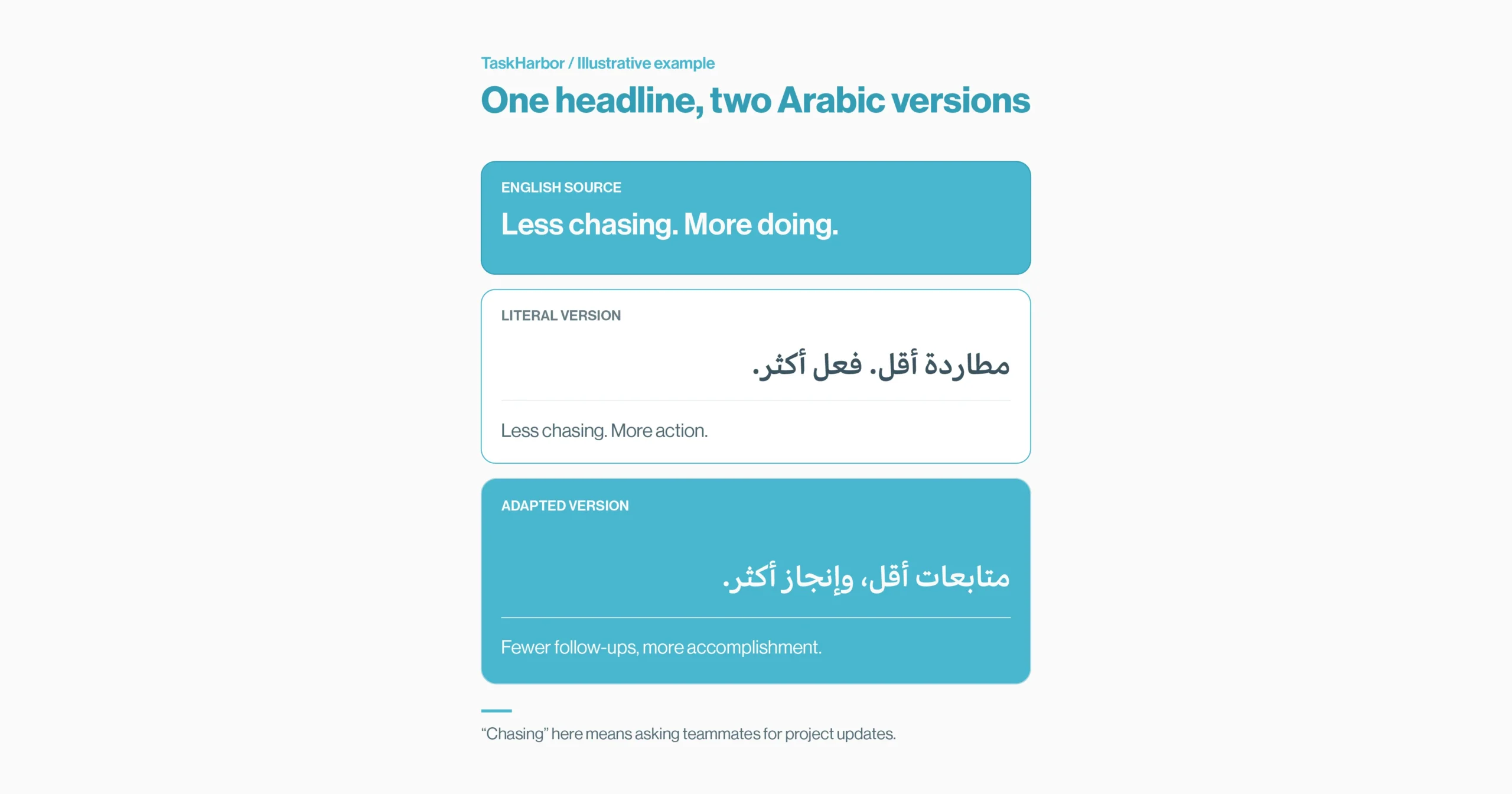
«مطاردة» suggests pursuit rather than routine follow-up. Readers may not connect it to asking colleagues for project updates. «فعل أكثر» also sounds awkward as an Arabic advertising phrase.
The revised version communicates the intended benefit: fewer follow-ups and more completed work. It assumes the brief confirms that meaning.
The English gloss alone does not reveal every weakness. I would use back-translation to discuss meaning alongside direct review of the target-language wording.
2. A Button: Describe the Actual Next Step
Source button: “Get started.”
Literal but vague version: «ابدأ الآن.»
Back-translation: “Start now.”
Suppose the button opens a calendar to book a product demonstration. Some visitors may expect immediate software access.
Improved version: «احجز عرضًا توضيحيًا.»
Back-translation: “Book a demonstration.”
I would flag the English button too. Clarifying the source helps every language version.
If the destination instead offers registration for a free 14-day trial, a suitable alternative is:
«جرّب مجانًا لمدة 14 يومًا.»
Back-translation: “Try it free for 14 days.”
Confirm the destination before approving the button. Booking a demo and starting a trial are different actions.
3. A Brochure: Make the Benefit Easy to Read
Source: “See who’s doing what, without digging through email threads.”
Understandable but stiff version:
«اطّلع على من يقوم بماذا دون البحث في سلاسل البريد الإلكتروني.»
Back-translation: “See who is doing what without searching through email chains.”
Improved version: «اعرف مهام فريقك دون البحث بين رسائل البريد.»
Back-translation: “Know your team’s tasks without searching through email messages.”
The revised line communicates the benefit more briefly and avoids the less natural expression «سلاسل البريد الإلكتروني».
This works where the brochure has already established task visibility. If individual responsibility is the main point, use a more explicit phrase: «اعرف مَن يتولى كل مهمة» “Know who is responsible for each task.”
The surrounding content determines which detail deserves emphasis.
Check What Happens to the Translation in the Design
Inspect headings, buttons, line breaks, fonts, and text inside images.
Consider this Arabic line:
اشترك في TaskHarbor مقابل 49 USD شهريًا.
Meaning: “Subscribe to TaskHarbor for USD 49 per month.”
It combines Arabic with a Latin-script name, digits, and a currency abbreviation. Text runs or punctuation may appear in an unintended position, depending on how the line is handled. A line break may also separate the amount from the currency.
Check the actual export or page on a phone. Confirm that TaskHarbor remains readable, 49 stays clearly associated with USD, «شهريًا» describes the billing period, and punctuation appears correctly.
If the order is wrong, have the implementer correct text direction and handle the Latin-script runs appropriately. Retyping words in reverse order can create problems elsewhere.
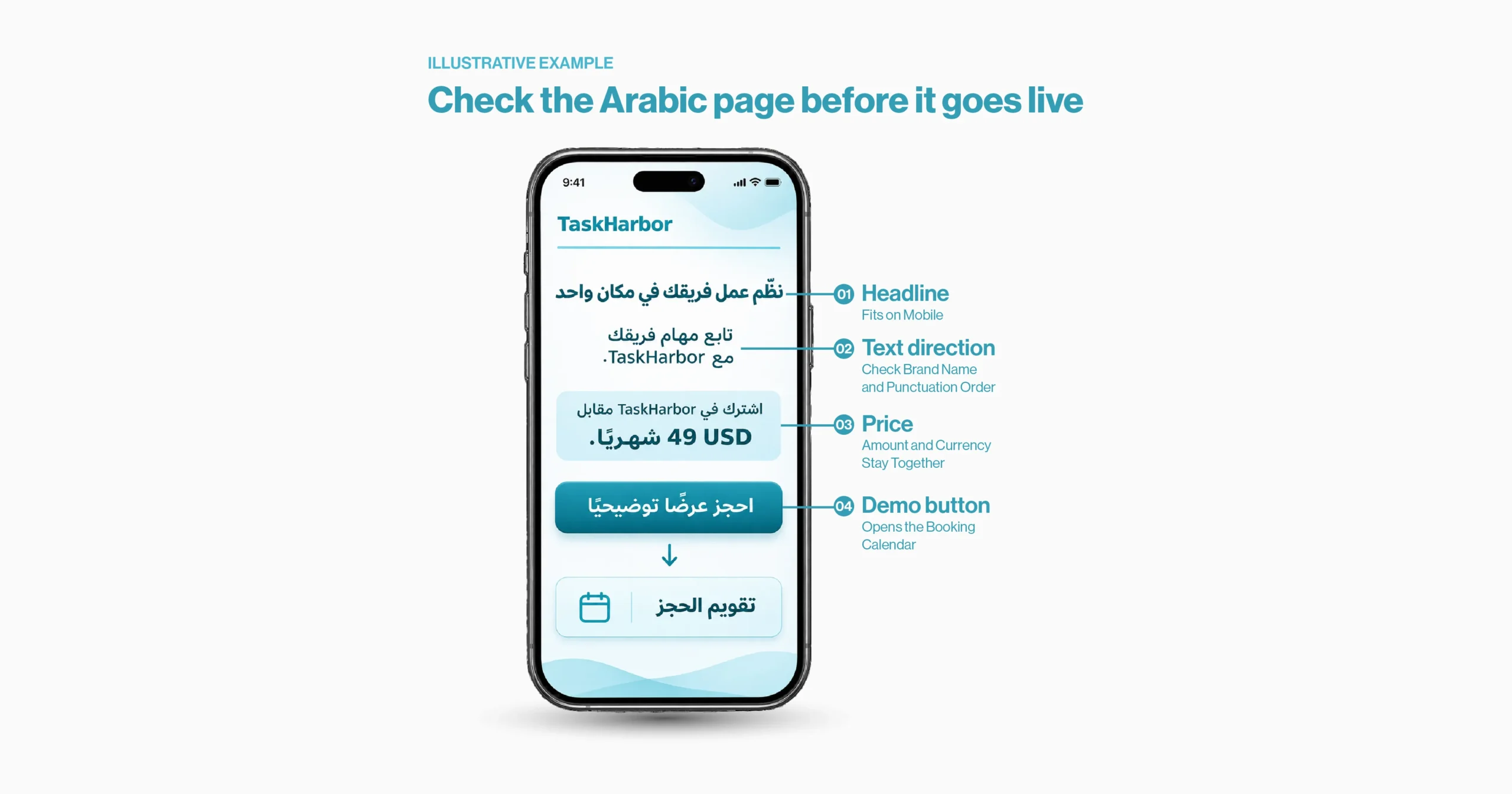
I would approve the final output, including links and account handles, rather than assume that a clean translation document guarantees a clean design.
What Should You Receive from a Marketing Document Translation Project?
Marketing document translation may cover text alone or include editing, formatting, and layout review. Confirm the scope before accepting a quote.
Agree on editable files, formatted outputs where commissioned, creative alternatives where included, and any unresolved queries. Also confirm the revision allowance and who reviews the final design.
My main question would be: “Which files will be ready to publish, and which will still need work from our team?”
Keep Multilingual Marketing Materials Updated
Track each asset and language against its approved source version. Record the reviewer, approval date, and publication status.
If a trial changes from 14 to 30 days, update every affected ad, page, brochure, and automated email. Translation memory can help reuse wording, but it cannot decide whether an old offer remains valid.
I would assign one person to coordinate updates. Otherwise, different languages can remain accurate against different versions of the campaign.
Where I Would Use AI and Where I Would Budget for Creative Work
|
Content |
Possible starting point | Required attention |
|
Repeated product descriptions |
AI draft with approved terminology |
Facts, terms, tone |
|
Routine email updates |
AI draft where suitable |
Meaning, offer, action |
|
Brochure copy |
Draft assessed against the brief |
Benefits, claims, readability |
|
Slogans and wordplay |
Human-led creative development |
Alternatives, reasoning, market fit |
| Promotional conditions | Closely controlled translation |
Numbers, restrictions, exclusions |
Consider this hypothetical error:
Source: “Save up to 30% on selected plans.”
Faulty Arabic: «وفّر 30% على جميع الخطط.»
Back-translation: “Save 30% on all plans.”
Corrected: «وفّر حتى 30% على خطط مختارة.»
Back-translation: “Save up to 30% on selected plans.”
The faulty version changes both the saving and the restriction. This error could come from AI or a person. Check the offer against the source rather than judging fluency alone.
Before uploading confidential materials, confirm the tool’s data-handling terms and your organization’s requirements.
When You May Not Need an External Translator
You may be able to handle a routine update internally if you have approved translations, a capable target-language editor, and no new message to develop.
I would not recommend transcreation for changing opening hours. Equally, I would not publish a new slogan solely because a grammar checker approved it.
How Much Does Marketing Translation Cost?
Separate straightforward translation from creative development.
For illustration, 1,000 source words quoted at $0.10 per word would cost $100 for one language. This is a calculation example, not a ClickTrans quote or an industry average. Editing, formatting, and layout review may be priced separately.
For transcreation, ask for a project or time-based quote. A five-word slogan may involve several concepts, explanations, and approval rounds.
Compare the agreed deliverables: languages, alternatives, review stages, revisions, formatting, and treatment of source changes. A lower word rate does not establish which proposal includes the work you need.
How Do You Know the Translation Is Working?
Track results by language, market, and channel. Review ad click-through rates alongside landing-page conversions. If clicks rise but completed forms fall, inspect the page and form.
Where traffic allows, test two approved headlines in the same language. Keep the offer, audience, budget, and destination comparable. Choose the main success measure beforehand and avoid declaring a winner from a few visits.
Read customer questions too. Repeated confusion about eligibility or trial terms may reveal wording that needs attention.
I would investigate performance changes before attributing them to translation. Pricing, targeting, technical problems, and the offer also affect results.
Before You Launch
- Verify figures, product names, conditions, and offer dates.
- Confirm appropriate language review for every version.
- Check headings, buttons, graphics, and reading direction.
- Test links, forms, tracking, and confirmation messages.
- Remove outdated copy and unintended source-language text.
- Match published files to their approved versions.
- Assign responsibility for future updates.
FAQ About translate marketing materials
Q1: What Is the Difference Between Marketing Translation and Transcreation?
A1: Marketing translation conveys promotional content accurately and naturally, including its tone and purpose. Transcreation allows more substantial rewriting when the expression depends on wordplay, humor, rhythm, or a campaign concept.
Both can appear in one project. A brochure may need accurate specifications and creative headline alternatives. I would choose the treatment for each passage rather than apply transcreation to every word.
Q2: How Much Does It Cost to Translate Marketing Materials?
A2: The price depends on the languages, content, and deliverables. As an example, 1,000 source words at a quoted rate of $0.10 would cost $100 per target language before separately priced services. That is an illustration, not a universal rate.
Creative work may be quoted per project or by time. Ask whether editing, alternative headlines, explanations, formatting, revisions, and final layout checks are included.
Q3: Can I Use AI to Translate Marketing Materials?
A3: AI may provide a useful draft for some routine content when the source and terminology are clear. The output still needs review for meaning, conditions, tone, and audience suitability.
For slogans and campaign concepts, I would budget for human-led creative work. For simple updates, an internal language editor may be sufficient. Choose according to the content and your ability to check it.
Q4: How Can I Review Translations If I Do Not Speak the Language?
A4: Appoint a qualified reviewer for each target language and provide the approved source, brief, and design context. Your marketing or product owner should approve facts and offer conditions.
For creative options, request explanations and back-translations. These support your decision, but do not replace review of the target-language text or final design.
Ready to Translate Your Marketing Materials?
Send ClickTrans one ad and its landing page, together with your target languages, markets, and launch date. We can discuss which parts need translation, which may need adaptation, and whether formatting or final layout review should be included.
Explore our marketing translation services and request a quote for your campaign.