info@clicktranss.com



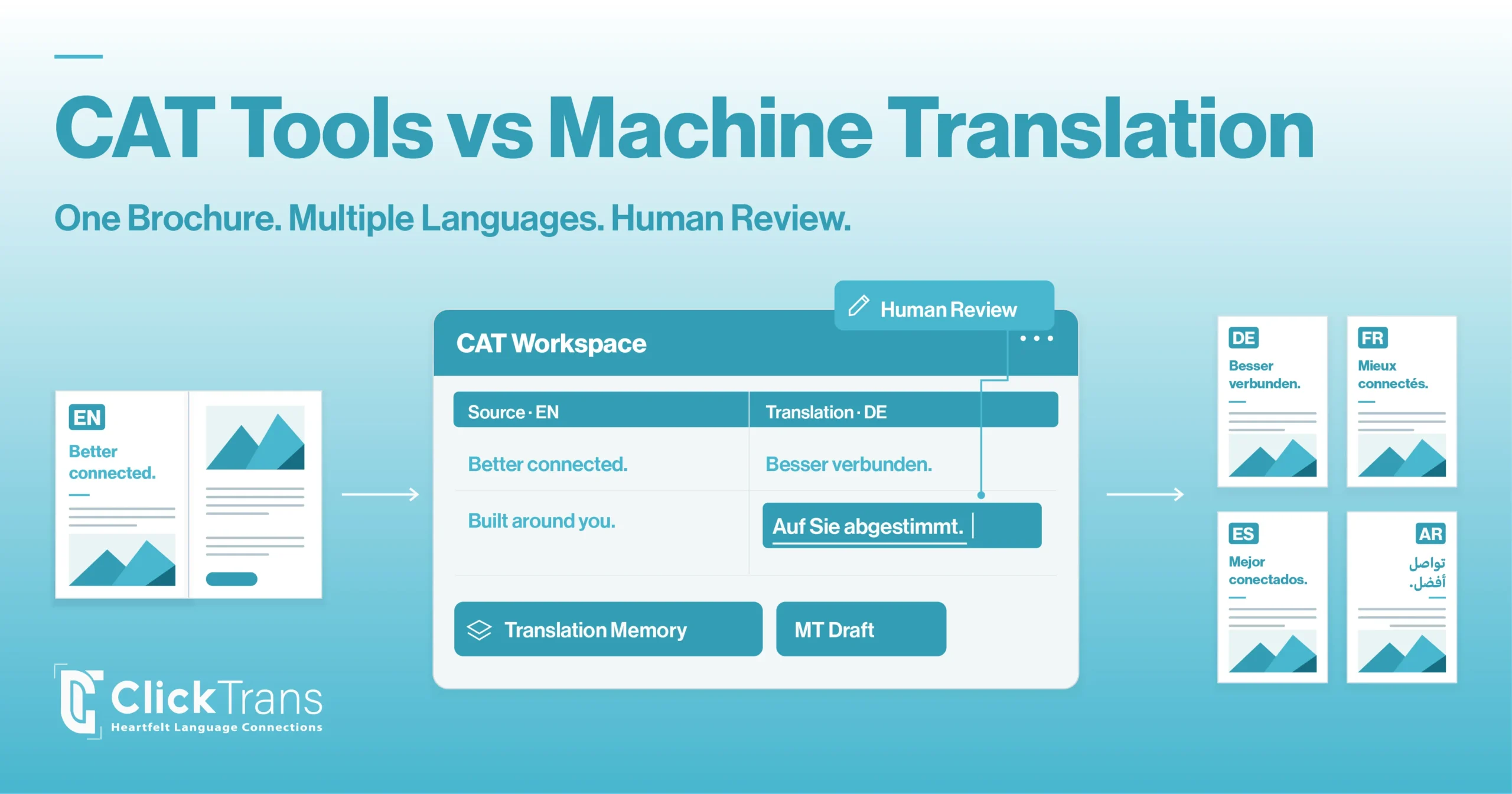
Table of Contents
Your company is launching a software product and needs its brochure translated into German, French, Spanish and several other languages. Some paragraphs are unchanged, product details have been revised, and a new section has been added. What can your translation provider reuse, what needs translating, and who checks each version before delivery?
Understanding CAT tools vs machine translation helps you assess the process behind the quote. We’ll follow a multilingual brochure update to show where stored translations, machine drafts and professional judgment fit into the work.
What’s the Difference Between CAT Tools and Machine Translation?
A computer assisted translation (CAT) tool is a workspace that helps a translator use translation memory, terminology resources and quality checks. Machine translation (MT) generates translated text automatically and can supply drafts inside that workspace.
These are different functions. A CAT tool organizes the work and presents resources; an MT engine generates a possible translation. A provider can use them together or work in a CAT environment without enabling MT.
| Human translation with CAT support | Unreviewed machine translation | MT with human post-editing | |
| Who produces the translation | The translator, supported by resources | The engine | The engine drafts; a linguist revises |
| Resources used | Translation memory, glossary and reference materials | The engine’s model and configured resources | Memory, glossary, reference materials and machine drafts |
| Who checks it | Translator, supported by automated checks | No human review included | Linguist, supported by automated checks |
| Typical use | Content needing close control of meaning and wording | Low-risk internal understanding where errors are tolerable | Content with a usable draft and a defined quality target |
| Main risk | Unsuitable memory entries carried forward | Errors reaching the reader unchecked | Insufficient review of the draft |
Machine translation software can also process whole files. Receiving a translated brochure, however, does not establish that anyone has checked its claims, terminology or suitability for the intended market.
For a buyer comparing CAT tools vs machine translation, the important distinction is how suggestions become approved content.
What Happens During a Multilingual Brochure Update?
The provider imports the source file into a CAT tool, which separates its text into segments, usually sentences or headings. For each target language, the editor can display stored translations, terminology suggestions and, if enabled, machine drafts.
The available resources may differ between languages. Your provider might have an approved French translation from the previous edition but no equivalent Polish version. The French team can assess existing matches, while the Polish team needs to produce more new text.
Here is an illustrative example rather than a screenshot of a client project:
| Source text | Possible suggestion | Linguist’s decision |
| Designed for everyday use. | An exact match from the previous brochure in a particular target language. | Confirm that it still describes the product accurately and fits the surrounding copy. |
| The system can take permitted actions within configured limits. | A machine draft may weaken or omit “permitted” or “within configured limits.” | Preserve both qualifications so the translation does not imply unrestricted autonomy. |
| Less admin. More time for your customers. | No suitable memory match. A machine draft may appear if enabled. | Translate or revise the headline for meaning, tone and space. Check that it works with the brochure’s visual message. |
In technical marketing, a small wording change can expand a product claim. Reviewers must preserve permissions, limitations and conditions alongside the promotional message.
This is where CAT tools vs machine translation becomes a practical purchasing question: which suggestions are available, and who takes responsibility for checking them?
Why Does Each Language Need Its Own Review?
A shared English source does not produce identical translation challenges across markets. Terminology, grammar, tone and layout requirements vary.
For example, changing “10 seconds” to “15 seconds” in Arabic changes the noun form:
“10 ثوانٍ” becomes “15 ثانية”. Updating the number alone is insufficient. Other languages may introduce different grammatical or stylistic requirements.
Marketing copy also needs attention to how the message reads. A headline that closely follows the English may communicate the basic meaning yet sound awkward in the target language. If substantial creative adaptation is required, agree on that scope before work begins.
Comparing CAT tools vs machine translation will not resolve these decisions by itself. The brief should identify target markets, approved technical terminology, brand voice and product claims. Reviewers should preserve conditions relating to availability, integrations, permissions and deployment.
What Should You Know About Matches and Quality Checks?
A 100% memory match indicates an exact source-text match under the tool’s matching rules. It does not guarantee that the stored translation is appropriate for the current brochure. Context, product details and approved terminology still need checking.
Automated quality estimates have limits too. A score attached to a machine-generated draft can help guide review, but it does not establish that the translation is ready for delivery.
When assessing CAT tools vs machine translation, distinguish automated signals from the checks a qualified linguist actually performs.
From Practice: Reviewing a Brochure in a CAT Tool
In a marketing brochure post-editing assignment, we reviewed the Arabic version in a CAT environment that displayed machine-generated suggestions alongside the source text and a document preview.
During QA, the system flagged a product name as a possible spelling error and flagged segments whose translations were identical to the tool’s suggestions. Both required judgment: an approved product name may need to remain unchanged, while a translation that matches a machine suggestion may still be correct.
An unchanged suggestion is therefore neither proof of an error nor evidence that a review took place. The linguist must assess the text against the source, terminology and context.
This example comes from Arabic post-editing, but the distinction applies across multilingual projects: automated checks support review, while each language version requires its own linguistic decisions.
Can You Use a CAT Tool Without MT?
Yes. Computer assisted translation does not require machine-generated drafts. A translator can retrieve approved memory entries and write new segments directly.
Two possible workflows are:
- Human translation with CAT support: the translator reviews memory matches and writes new material.
- MT with human post-editing: the linguist checks machine drafts against the source and revises them to the agreed standard.
A multilingual project can use different approaches for different content or language versions, provided those decisions are agreed. A product description and a campaign headline may require different treatment.
For buyers considering CAT tools vs machine translation, ask about the actual project configuration, including whether subcontractors will use MT.
Where Do AI Chat Tools Fit?
A general-purpose AI tool can also generate translation drafts. Ask the same questions you would ask about machine translation software: what content will it process, who checks its output, and what data-handling terms apply?
Whatever generates the draft, confirm which source comparisons, terminology checks and final-file checks the service includes. An automated second pass should not be confused with an agreed human review.
How Does the Workflow Affect Your Quote?
Translation memory and repetitions can reduce the amount of new translation required. They do not eliminate review: a sentence approved for an earlier brochure may need updating.
Costs can also differ between target languages because the available memories and draft quality differ. Ask for a breakdown that makes those differences understandable.
For a meaningful CAT tools vs machine translation price comparison, check how the provider charges for memory matches, new text, post-editing, creative adaptation and layout work. Confirm whether a separate reviewer is included.
A lower rate is difficult to assess without knowing the work covered by it.
What Happens Before Delivery?
For supported formats, translated content is exported into target files. Each language version then needs its own final-file check.
Reviewers should examine:
- Text expansion, line breaks and overflowing text boxes.
- Fonts, accented characters and missing glyphs.
- Prices, percentages, product names and contact details.
- Headings, captions and their relationship to images.
- Right-to-left layout and mixed-direction text where applicable.
A glossary helps maintain approved product names, while layout review checks how those names appear in the finished brochure.
The CAT tools vs machine translation discussion should therefore include delivery: who checks the exported versions, and who corrects any layout problems?
What Should You Ask Before Sharing Files?
- Will an MT engine or generative AI tool process any of my content? Identify the material and language versions involved.
- Which service will process it, and what data-handling terms apply?
- Who reviews memory matches and generated drafts in each language? Confirm the reviewer’s role and the required standard.
- Does the quote include marketing adaptation and final-layout checks? Agree on what each service covers.
- Can you supply project-specific translation memories and glossaries? Confirm formats, availability and any additional cost.
Your provider’s answers make CAT tools vs machine translation a concrete purchasing decision: you know how each version will be produced, reviewed and delivered.
If you’re comparing the workspaces themselves, our guide to the best CAT tools for translation explains the options and their differences.
Launching a software product across multiple markets? Share your brochure, target languages and deadline with ClickTrans to discuss technical terminology, marketing adaptation and final-layout review.
Frequently Asked Questions
Q1: Do I need to buy a CAT tool to work with a translation provider?
A1: Usually, no. Your provider can manage the translation environment. Supply editable source files, previous translations and brand guidelines, and agree on the delivery formats.
Q2: Can one translation memory cover every target language?
A2: Translation memories store source-and-target text pairs. Some systems manage multiple languages, but an approved French translation does not provide an approved German version. Ask what reusable resources exist for each language pair.
Q3: Is machine post-editing suitable for marketing brochures?
A3: It can be suitable when the draft is usable and the review requirements are clear. Headlines, slogans and persuasive copy may need substantial rewriting or transcreation, so agree on their treatment separately.