info@clicktranss.com


Table of Contents
Arabic is one of the most widely spoken languages in the world, with more than 400 million speakers across the Middle East and North Africa. While many people refer to “Arabic” as a single language, the reality is far more complex. Arabic consists of numerous regional dialects that vary significantly in pronunciation, vocabulary, grammar, and cultural expression.
From the Gulf region to the Levant and North Africa, Arabic dialects reflect centuries of history, migration, trade, and cultural exchange. Understanding these differences is essential not only for linguists and learners, but also for businesses, translators, and organizations working across Arabic-speaking markets.
In today’s global economy, accurate Arabic translation services require more than standard language knowledge. They demand a deep understanding of dialects, local culture, and regional communication styles.
The Origins of Arabic Dialects
Arabic belongs to the Semitic language family and traces its roots back to Classical Arabic, the language of early Arabic literature and the Quran. Over time, as Arab populations expanded across different regions, local speech evolved under the influence of geography, tribal diversity, foreign languages, and historical events.
Modern Standard Arabic (MSA) remains the formal written language used in media, education, and official communication. However, everyday conversations across the Middle East rely heavily on regional dialects.
These spoken dialects developed naturally over centuries and became unique linguistic systems with their own accents, idioms, and vocabulary.
Major Arabic Dialect Groups in the Middle East
Gulf Arabic
Spoken in countries such as Saudi Arabia, the United Arab Emirates, Kuwait, Qatar, and Bahrain, Gulf Arabic is known for its Bedouin linguistic roots and distinctive pronunciation patterns.
This dialect contains vocabulary influenced by Persian, Hindi, and English due to centuries of trade and international interaction.
Levantine Arabic
Levantine Arabic is commonly spoken in Lebanon, Syria, Jordan, and Palestine. It is often considered one of the easiest Arabic dialects for learners because of its softer pronunciation and widespread use in entertainment and media.
Levantine dialects are rich in expressions and vary slightly between urban and rural communities.
Egyptian Arabic
Egyptian Arabic is one of the most widely understood dialects in the Arab world because of Egypt’s historical influence in cinema, television, and music.
It differs from Gulf and Levantine Arabic in pronunciation and vocabulary, yet many Arabic speakers can understand it due to media exposure.
Iraqi Arabic
Iraqi Arabic combines influences from ancient Mesopotamian civilizations, Turkish, Persian, and Kurdish languages. Its pronunciation and sentence structure can differ greatly from neighboring dialects.
This dialect also contains significant variation between northern and southern Iraq.
Why Arabic Dialects Differ So Much
One of the most fascinating aspects of Arabic is how dramatically dialects can differ from one region to another.
Several factors contributed to this linguistic diversity:
- Historical migration and tribal settlement
- Influence from neighboring civilizations
- Colonial and trade interactions
- Geographic separation between regions
- Cultural and social development over centuries
For example, Gulf Arabic may include Persian-influenced words, while Levantine Arabic contains expressions shaped by Turkish and French influence.
Even simple daily vocabulary can vary widely between countries.
Comparison Table: Common Words Across Arabic Dialects
| English Word | Gulf Arabic | Levantine Arabic | Egyptian Arabic | Iraqi Arabic |
| How are you? | Shلونك | Kifak / Kifik | Ezzayak | Shakhbarak |
| What? | Shنو | Shu | Eh | Shinu |
| Now | الحين | هلق | دلوقتي | هسه |
| Very good | زين | منيح | كويس جدًا | زين كلش |
| Car | سيارة | سيارة | عربية | سيارة |
This comparison highlights how vocabulary and pronunciation can vary significantly even for basic expressions.
The Challenge of Translation Between Arabic Dialects
Many people assume that translating Arabic content is straightforward because the language shares a common writing system. However, dialect differences create major challenges in communication and localization.
A phrase that sounds natural in Egypt may feel unfamiliar or overly formal in Saudi Arabia. Similarly, marketing campaigns that work well in Lebanon may not resonate with audiences in the Gulf region.
This is especially important in industries such as:
- Marketing and advertising
- Legal translation
- Healthcare communication
- Media localization
- Customer support services
- Website and app localization
Professional Arabic translators must understand both Modern Standard Arabic and regional dialect variations to ensure accuracy and cultural relevance.
Arabic Dialects and Digital Communication
Social media and digital platforms have transformed how Arabic dialects are used online. People increasingly write in their local dialects instead of Modern Standard Arabic, especially on platforms like TikTok, Instagram, and YouTube.
This shift has created new opportunities and challenges for brands targeting Arabic-speaking audiences.
Localized Arabic content tends to generate:
- Higher engagement rates
- Better audience trust
- Stronger emotional connection
- Improved regional SEO performance
Businesses targeting Middle Eastern markets now prioritize dialect-specific content strategies to improve communication and brand visibility.
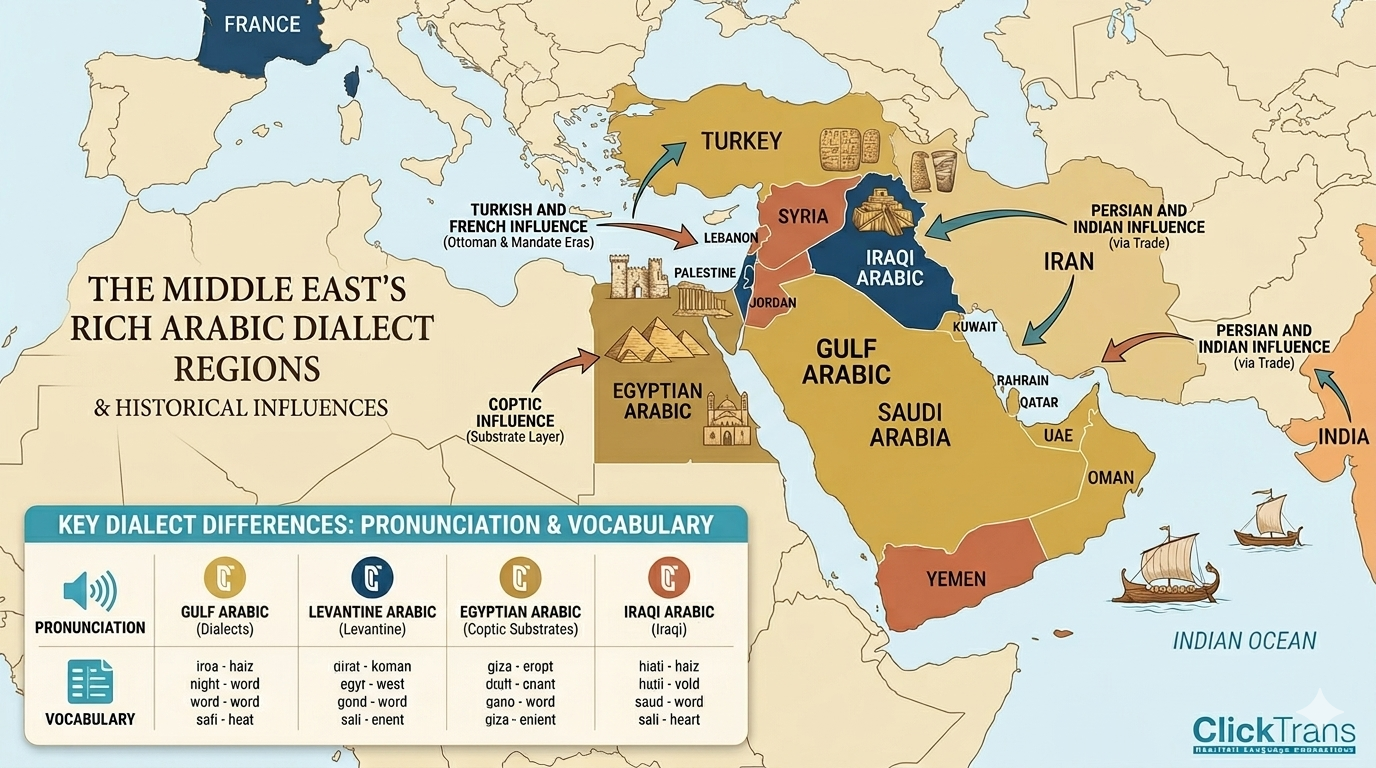
Important Visual Insight: The Influence Map of Arabic Dialects
One of the most interesting aspects of Arabic dialect evolution is the external linguistic influence on each region.
For example:
- Gulf Arabic was heavily influenced by Persian and Indian trade routes
- Levantine Arabic absorbed Turkish and French vocabulary during Ottoman and colonial periods
- Egyptian Arabic developed unique pronunciation patterns due to Coptic linguistic influence
- Iraqi Arabic retained elements connected to ancient Mesopotamian linguistic heritage
This historical blending explains why Arabic dialects sound dramatically different despite sharing the same linguistic foundation.
This section could be turned into an AI-generated infographic or regional dialect map showing linguistic influences across the Middle East. A visual representation comparing pronunciation, vocabulary roots, and historical influence would make the topic highly engaging for readers and increase social sharing potential.
The Role of Professional Arabic Translation Services
For businesses and organizations operating internationally, understanding Arabic dialects is essential for effective communication.
Professional translators do more than convert words—they adapt tone, terminology, and cultural context for specific audiences. This process helps ensure clarity, trust, and stronger engagement across Arabic-speaking regions.
Whether translating legal documents, websites, healthcare materials, or marketing campaigns, dialect awareness can significantly improve communication quality and audience response.
ClickTrans Arabic translation services help businesses and individuals navigate these linguistic differences with accurate, culturally adapted translations tailored for diverse Middle Eastern audiences.
Final Thoughts
Arabic dialects reflect the rich cultural and linguistic diversity of the Middle East. Understanding these regional differences is essential for accurate communication, localization, and audience engagement across Arabic-speaking markets.
At ClickTrans, we specialize in professional Arabic translation services tailored to different Arabic dialects, including Gulf, Levantine, Egyptian, and Iraqi Arabic. Our expert linguists ensure culturally accurate translations that help businesses and individuals communicate effectively across the Middle East.
If you need reliable Arabic translation and localization services, ClickTrans provides accurate solutions designed for real regional understanding.
Frequently Asked Questions
What is the difference between Modern Standard Arabic and Arabic dialects?
Modern Standard Arabic is the formal written version used in media, education, and official communication, while dialects are the spoken regional variations used in everyday conversation.
Which Arabic dialect is the most widely understood?
Egyptian Arabic is often considered the most widely understood dialect because of Egypt’s long-standing influence in Arabic movies, television, and music.
Why are Arabic dialects important in translation?
Arabic dialects affect vocabulary, tone, and cultural meaning. Using the wrong dialect can reduce clarity and audience engagement, especially in marketing, customer communication, and localization projects.