info@clicktranss.com



Table of Contents
A company launches a campaign in a new language. The slogan sounds awkward, the price breaks across two lines, or the button promises something the next page doesn’t deliver.
When a client sends me an ad or a landing page, I start by asking where the copy will appear and what happens after someone clicks. Those answers shape both the wording and what I include in the quote.
Here are nine common marketing translation mistakes to avoid, with questions to ask before hiring a provider for marketing content translation. I’ll also explain when transcreation services are worth including in the brief.
For a step-by-step guide to running the project, see How to Translate Marketing Materials: From Brief to Launch.
Nine Common Mistakes
1. Choosing a provider on price per word alone
A price per word is easy to compare, but it does not tell you what the quote includes. Two offers at the same rate can differ in editing, review by a second linguist, layout checks and the number of revision rounds.
Ask: What is included in this price, and what is charged separately?
Illustrative example: Two quotes for the same campaign
Suppose TaskHarbor requests Arabic translation for an ad and its landing page.
Quote A Quote B
Copy Translation and editing of the ad and landing page in an editable file Translation and editing, plus two headline options with a short explanation of each
Final layout The client’s team reviews the Arabic after it is placed in the design The provider reviews the Arabic ad and landing page as they appear on mobile and flags any issues
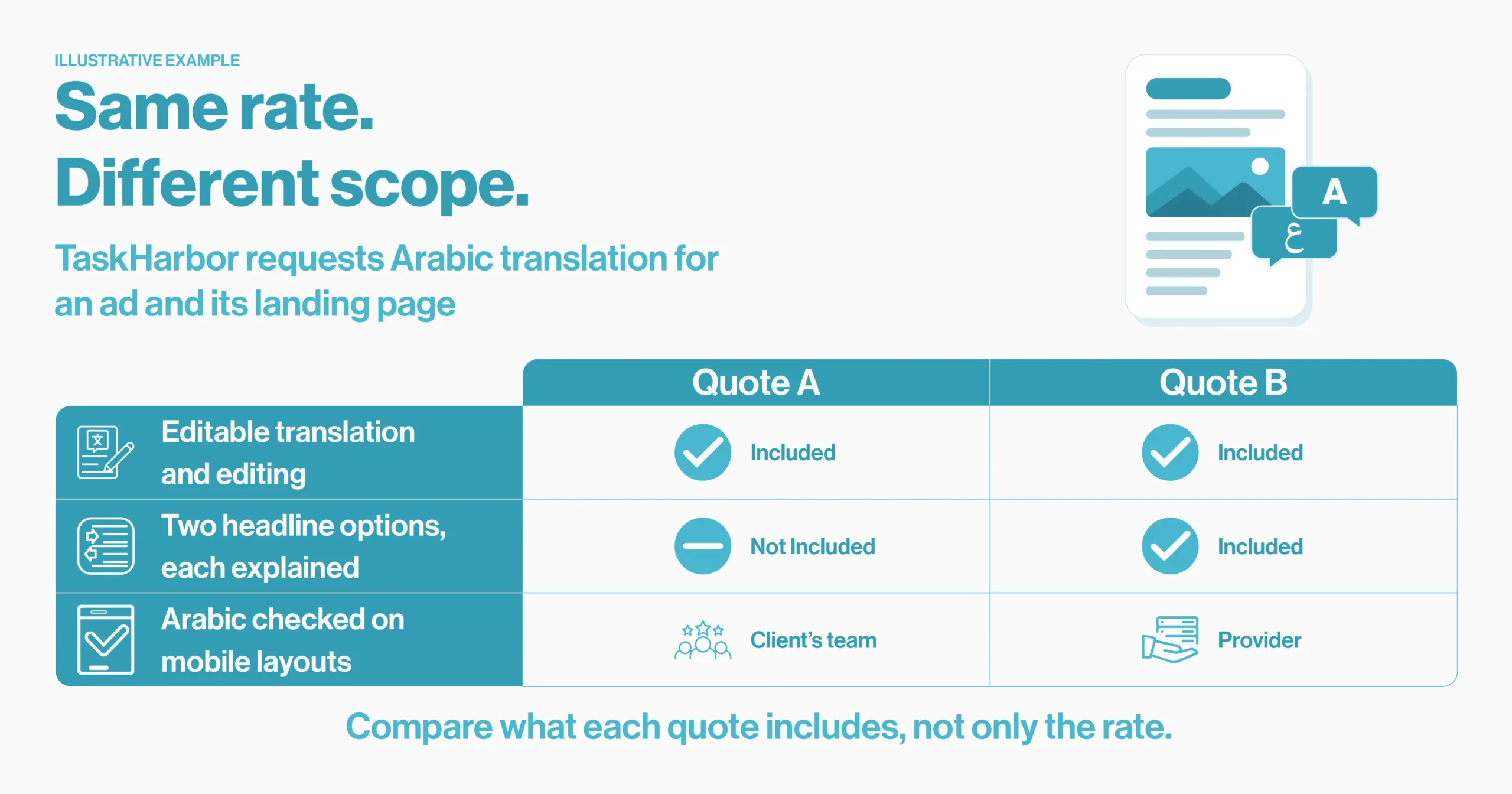
Quote A may be enough if your team has an Arabic reviewer and can handle design fixes. If you need the provider to check the mobile layouts, ask both providers to price that step before you compare totals. Confirm who will implement any corrections.
2. Translating a slogan literally
Slogans rely on rhythm and figurative language. What works in one language may mean nothing in another. Here is a fictional example:
• Source: “Hit the ground running.”
• Literal Arabic: «اضرب الأرض وانطلق ركضًا.» (back-translation: “Hit the ground and start running”)
• Adapted Arabic: «انطلق بقوة من اليوم الأول.» (back-translation: “Start strongly from day one”)
The back-translation shows how literally the first version follows the English. A qualified Arabic reviewer can assess whether the wording sounds natural as a campaign headline and whether it conveys the intended sense of a strong start.
Ask: Can you explain why this headline suits our audience and offer alternatives if it needs creative adaptation?
3. Not specifying the market and audience
“Arabic” is a language, not an audience. A campaign for company directors in Saudi Arabia may need a different register from one for consumers in Egypt. The same applies to numerals (Western or Arabic-Indic digits), currency formats and dates. The same question arises in Spanish, French, Portuguese and many other languages.
On an Arabic landing page for business buyers, I changed the price display from «٤٩ دولارًا» to “49 USD” to match the Western digits and currency code used in the client’s other materials. The revised price also fit on one line in the final layout.
Ask: How do you choose the language variety and decide how to display prices and dates for our target market?
4. Writing the source text to be “easy to translate”
Some teams simplify the English so that nothing can be mistranslated. The result is often correct but flat, and it persuades no one in any language. It is better to write the original naturally, then explain the intent, the audience and what may change.
Ask: Will you work from a brief that explains the intent, and do you ask questions when something is unclear?
5. Skipping the design check, especially for right-to-left languages
Text that looks fine in a Word file can break in the final layout. Consider this Arabic line:
«اشترك في TaskHarbor مقابل 49 USD شهريًا.»
It mixes Arabic, a Latin-script name, a number and a currency code. Depending on the layout, the amount may separate from its currency at a line break, or the punctuation may appear in the wrong place. These issues are visible only in the designed file or on the live page, so ask whether the final check is part of the service.
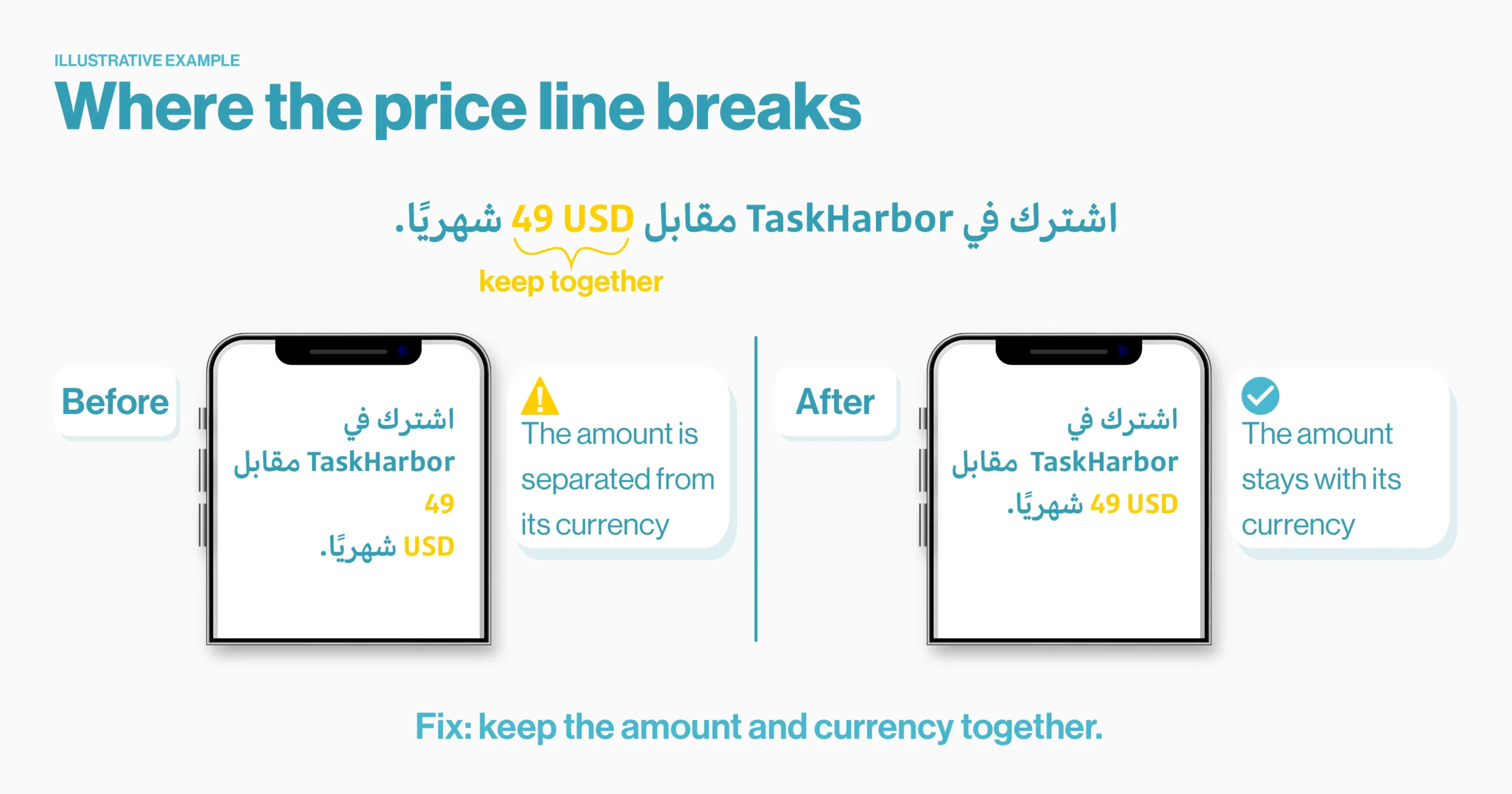
Ask: Who will check the Arabic ad and landing page on mobile, and who will apply any corrections?
6. Translating keywords without checking local search behaviour
A translated keyword is not necessarily a keyword people use. Searchers may use a different term altogether. Check the terms against local search data rather than assuming a literal translation will be used.
Ask: Do you verify keywords in the target market, or translate them as written?
7. Relying on machine translation without human review
AI can produce a fast, readable draft, and for repetitive content it can be useful. The risk is that fluent text may change a condition or promise. Another fictional example:
• Source: “Save up to 30% on selected plans.”
• Faulty Arabic: «وفّر 30% على جميع الخطط.» (“Save 30% on all plans”)
• Correct Arabic: «وفّر حتى 30% على خطط مختارة.» (“Save up to 30% on selected plans”)
The faulty version changes both the amount and the restriction. A person or a machine could produce it, so the check is against the source, not the fluency.
Ask: Where does AI enter your workflow, who reviews it, and how do you protect confidential files?
When I use machine translation for routine copy, I treat it as a first draft and check it against the source. For campaign headlines and calls to action, I draft the Arabic from the brief so the wording fits the audience and makes the next step clear.
8. No clear approval process
When three people comment with different preferences, revisions never end. Decide before the project starts who approves the language, who approves the offer and prices, and who gives the final sign-off. Separate corrections from preferences.
Ask: How do you handle conflicting feedback from several reviewers?
9. Translating only part of the journey
A translated ad that leads to an English form, or a translated page followed by an English confirmation email, breaks the customer’s path. Agree in advance on which assets launch together.
Ask: Does your proposal cover the whole journey, or only the files we sent?
Discover the best offers from Clicktrans for marketing translation services
When Do You Need Transcreation?
Standard translation conveys meaning accurately and naturally. Transcreation (sometimes called creative translation) gives the writer more freedom to rework an idea when the original expression does not work in the new language. You usually need it for:
• Slogans and campaign concepts
• Headlines built on wordplay, humour or a cultural reference
• Copy where brand voice carries much of the message
You usually do not need it for technical specifications, offer conditions, opening hours or routine updates. Those should be translated closely and checked against the source.
How is it priced? Standard translation is often priced per word. Transcreation is more often quoted per project or by time, because a five-word slogan may involve several concepts, explanations and approval rounds. As a calculation example, 1,000 words at $0.10 per word comes to $100 for one language. That is an illustration, not a quote, and services such as editing, formatting and layout review may be priced separately. Compare what each offer includes, not only the rate.
When a provider offers creative alternatives, ask for a plain-English explanation of each one and why it suits the audience. That lets you make an informed choice even if you do not read the language.
I decide line by line. If a product detail or offer condition carries over naturally into Arabic, I translate it. If a headline relies on wordplay that loses its effect in Arabic, I develop alternatives. For clients who don’t read Arabic, I explain what each option conveys and recommend the one that best fits the campaign.
Questions to Ask Any Provider Before You Sign
What to check A good sign A warning sign
Understanding the project Asks about audience, market and goal before quoting Sends a price as soon as the file arrives
Clarity of the quote States editing, review, formatting and number of revisions One total with no detail
Creative work Alternatives with explanations and selection criteria A single version with no reasoning
Design Reviews final files; has RTL experience if relevant Doesn’t specify who reviews the copy in the final layout
AI use Explains where it is used, who reviews it, how files are protected Promises instant, error-free results
Keywords Verifies them in the local market Translates them literally
Review and responsibility Names reviewers; separates errors from preferences Cannot say who checks what
Credentials Memberships and approvals you can verify General claims or guaranteed outcomes
I would also be cautious about any provider that guarantees a business result. Good translation protects your message, but your offer, targeting and pricing affect results as well.
How I Approach This at ClickTrans
At ClickTrans, I agree with the client on what the campaign can adapt, such as headlines and examples, and which details must stay exact, such as prices and offer conditions. ClickTrans is a corporate member of the American Translators Association (ATA).
If you are preparing a campaign, send us one ad and its landing page, with the languages, markets and launch date. We will tell you which parts need translation, which may need adaptation, and what a quote would cover. You can read more about our marketing translation services or request a quote there.
FAQ About Marketing Translation Mistakes
Q1: What is the difference between marketing translation and transcreation?
A1: Marketing translation conveys promotional content accurately and naturally, including tone and purpose. Transcreation allows more substantial rewriting when the expression depends on wordplay, humour or a campaign concept. Both can appear in one project, and the right choice depends on each passage.
Q2: How do I compare quotes for transcreation services?
A2: Compare what is included: the number of alternatives, the explanation of each, rounds of approval, layout review and the handling of source changes. A lower rate does not tell you which proposal includes the work you need.
Q3: Is AI enough for marketing content translation?
A3: It can provide a useful draft for routine content. The output still needs review for meaning, conditions and tone. Slogans and campaign concepts need creative human work.
Q4: How can I review a translation if I do not speak the language?
A4: Appoint a qualified reviewer for each language, give them the source, the brief and the design context, and have your product owner approve figures and conditions. Ask for explanations and back-translations of creative options, remembering that they support your decision but do not replace review of the target-language text.