info@clicktranss.com


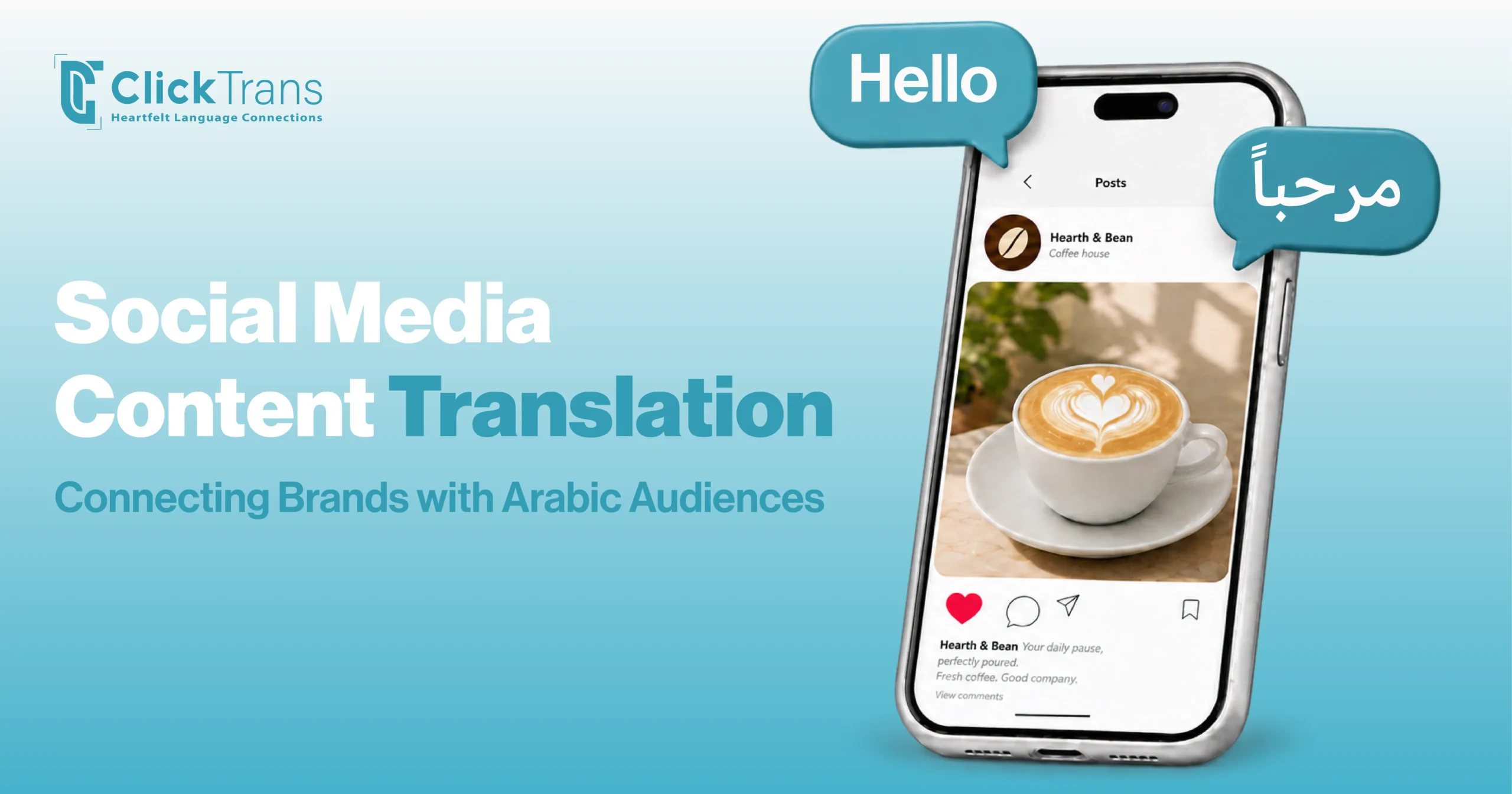
Table of Contents
Most social media content translation into Arabic fails quietly. The grammar is fine and the spelling is fine. The post just doesn’t sound like anyone your audience follows, so they scroll past it.
I’ve spent over eight years translating and localizing content for Arabic-speaking audiences, working across a range of industries and content types, including marketing, legal, healthcare, and business communications. This guide is what I’d tell you if we had an hour and you were planning your first Arabic campaign. It covers which Arabic to use, what breaks in right-to-left layouts, how Ramadan rearranges your calendar, how to run multilingual social media accounts, and how to tell if any of it is working.
Translation, localization or transcreation: what you’re actually buying
Vendor websites use these three words as if they mean the same thing. They don’t, and they aren’t priced the same either.
Translation carries meaning from English into Arabic as faithfully as possible. Social media localization adapts the whole post to one market: dialect, hashtags, visuals, posting time. Transcreation rewrites the idea itself when the original won’t survive the trip.
| Content | What I’d use | Why |
| Store hours, prices, product specs | Translation | Accuracy matters here. Personality doesn’t. |
| Corporate announcements, LinkedIn posts | Translation into MSA, lightly localized | Readers expect formal Arabic on these. |
| Instagram captions, Reels and TikTok hooks | Localization | Dialect, tone and hashtags decide whether anyone stops scrolling. |
| Slogans, puns, campaign taglines | Transcreation | Wordplay almost never crosses languages intact. |
| Comment replies and DMs | Localization by a native community manager | People notice canned replies in seconds. |
And honestly, a lot of your content doesn’t need transcreation. If you’re announcing opening hours for a new branch in Jeddah, a clean literal translation does the job. Paying a copywriter to make it sparkle is wasted budget.
Choosing your Arabic: MSA or dialect
This is the first real decision, and many brands get it wrong by using Modern Standard Arabic (MSA) everywhere. MSA is the Arabic of newspapers and news bulletins. Everyone understands it. Almost nobody chats in it.
So, an MSA caption on TikTok reads like a press release that wandered into a group chat. It’s correct. It’s also stiff.
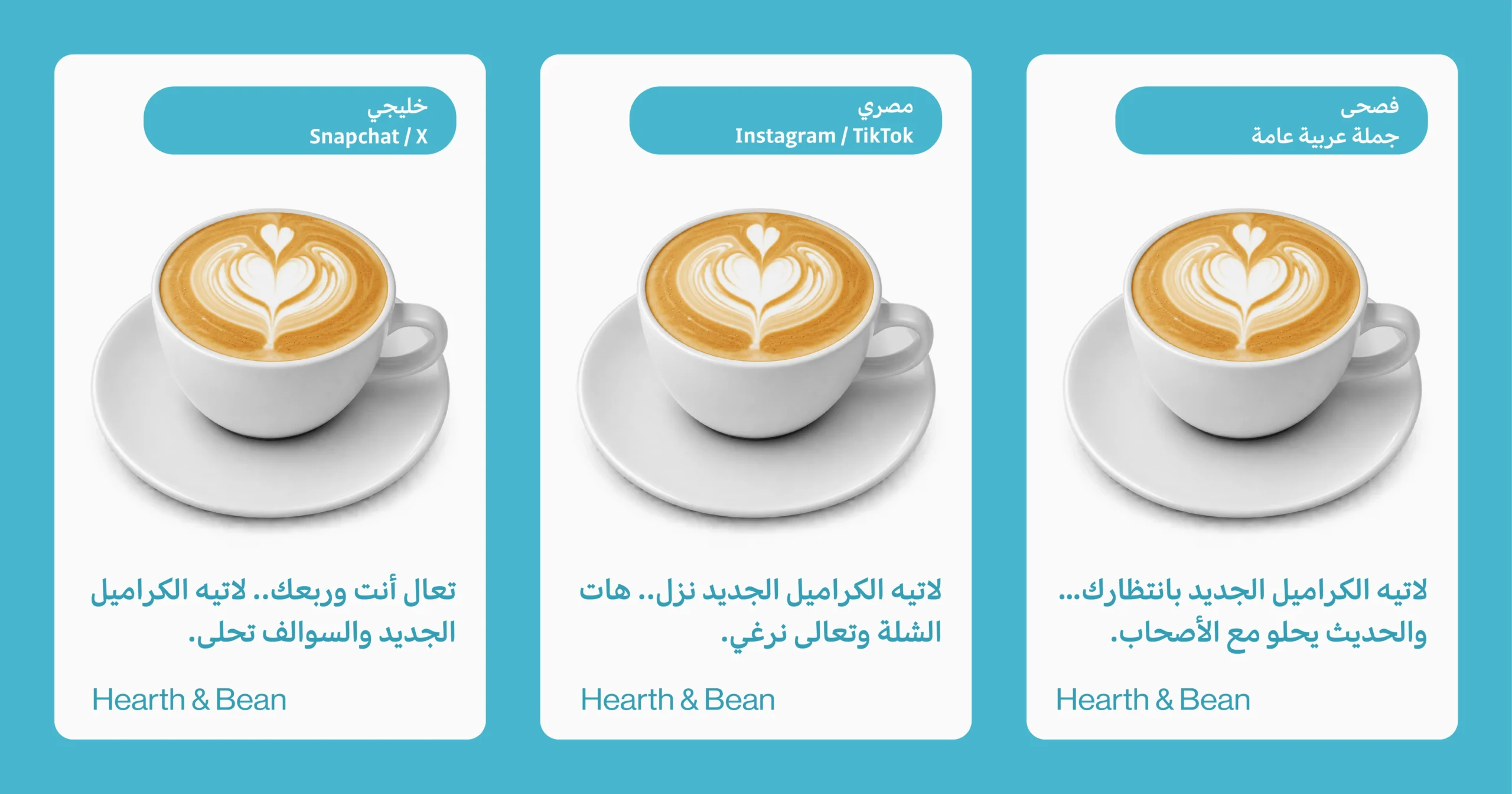
Here’s an example. Hearth & Bean is a café brand I made up for this article, launching a new drink:
New Caramel Latte. Come spill the beans with your crew.
The literal translation is the one that ends up as a screenshot:
لاتيه الكراميل الجديد. تعال واسكب الفاصوليا مع طاقمك.
Back-translated, that says “Come and pour the beans with your (ship’s) crew.” “Beans” became beans, “spill” became an actual spill, and “crew” now means the people who fly your plane.
These are the three versions I’d actually consider:
| Version | Arabic | Back-translation | Where I’d use it |
| MSA | لاتيه الكراميل الجديد بانتظارك… والحديث يحلو مع الأصحاب. | The new caramel latte awaits you… and conversation turns sweet among friends. | Pan-Arab campaigns, paid ads across several countries |
| Egyptian | لاتيه الكراميل الجديد نزل.. هات الشلة وتعالى نرغي. | The new caramel latte just dropped.. bring the gang and let’s chat away. | Instagram, TikTok and Facebook in Egypt |
| Gulf | تعال أنت وربعك.. لاتيه الكراميل الجديد والسوالف تحلى. | Come with your buddies.. the new caramel latte, and the chats get sweeter. | Snapchat, X and Instagram in Saudi Arabia, the UAE and Kuwait |
None of the three keeps the coffee-bean pun, and that’s on purpose. I don’t know of one for gossip, so forcing one in produces nonsense. The MSA and Gulf versions swap it for a different pun: يحلو and تحلى mean “gets sweeter,” which echoes the caramel. The Egyptian version uses نرغي, which is exactly what friends do over coffee for two hours.
My rule of thumb: MSA for pan-Arab campaigns, LinkedIn, and anything legal, medical or government-adjacent. Dialect for Instagram, TikTok and Snapchat when you’re targeting one country. I’d never mix dialects on one account. An Egyptian joke on a Saudi-focused account reads as if an outsider wrote it, because one did.
Gulf Arabic isn’t one dialect either. ربع and سوالف work across the region, but a campaign aimed only at Kuwait or only at Riyadh can go more local than that.
The gendered “you”
English “Come” hides something Arabic can’t. The verb changes with gender and number: تعال for a man, تعالي for a woman, تعالوا for a group. Most brands default to the masculine without thinking about it.
Some brands write تعال/ي with a slash. On a government form that’s fine. In an Instagram caption it looks like a form. I’d use the plural for most social copy, since it sounds natural in both Gulf and Egyptian Arabic and includes everyone. The exception is a product aimed squarely at women. Then talk to women.
Arabic social media localization: where RTL layouts break
Arabic reads right to left. That sounds like a typesetting detail until you see how much of a post’s visual logic runs left to right.
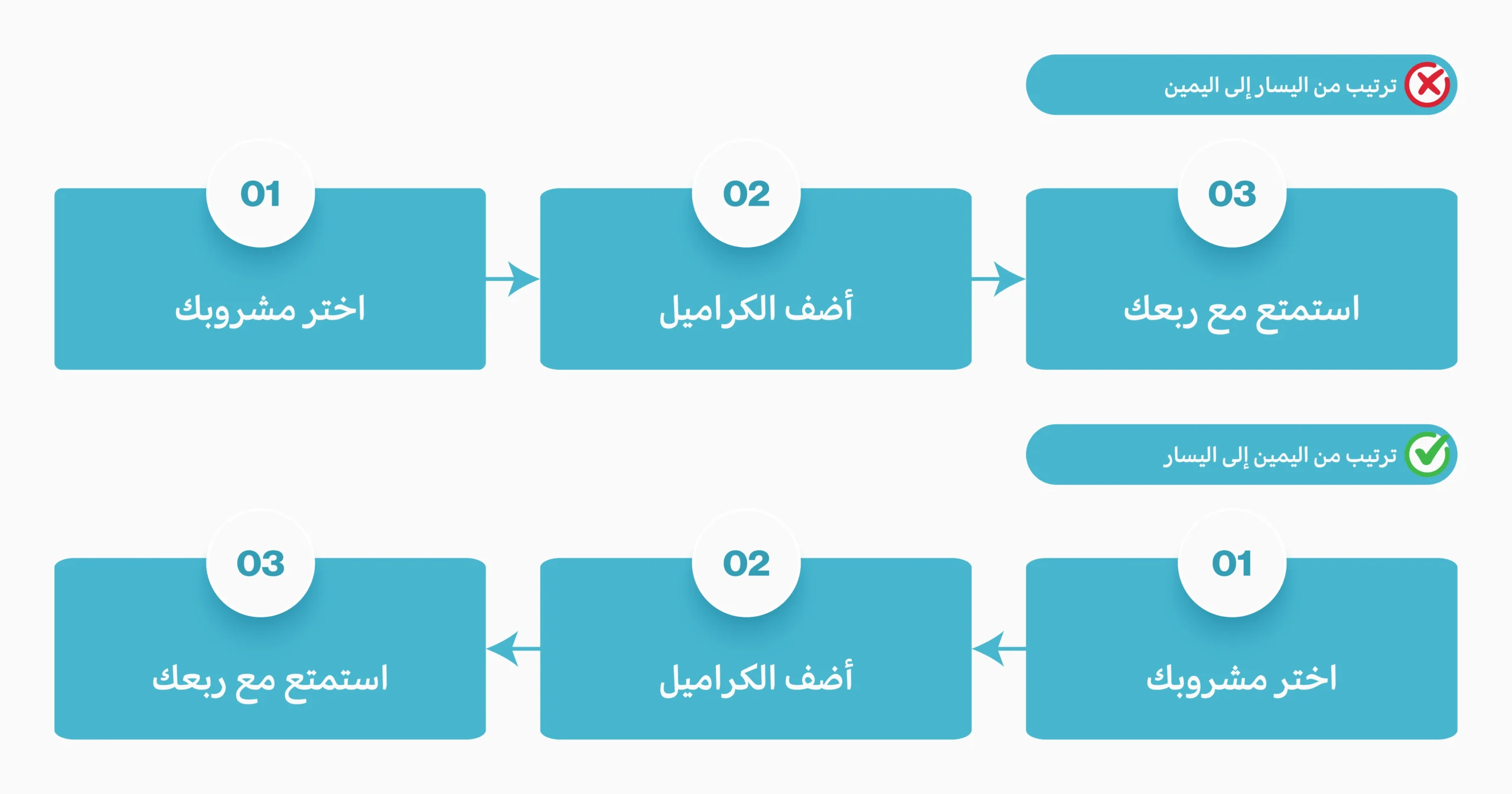
There’s an old marketing story about a detergent ad: dirty laundry on the left, the box in the middle, clean laundry on the right. Read right to left, the detergent makes your clothes dirty. Nobody’s sure it really happened, but the problem is real. I still see it in before/after carousels, timelines, arrows and “step 1, 2, 3” graphics.
For example, a three-step infographic designed in English may retain its left-to-right sequence after being translated into Arabic. This can confuse readers because the first step appears on the left instead of the right. To fix this, the layout and arrows should be reversed to follow the Arabic reading direction, not just the text translated.
Broken letters are worse. Arabic letters connect and change shape depending on their position in a word. Some design tools and templates don’t support Arabic shaping, so the text exports as disconnected letters running the wrong way. It’s unreadable, and it usually happens when a designer pastes Arabic into a template built for English. So, check the final exported file on a phone, not the design file.
Fonts cause quieter problems. A thin weight that looks elegant in Latin script disappears on a small screen in Arabic. Tight line spacing clips the dots that tell ب from ت from ث, and those dots carry meaning.
Mixed-direction text breaks in ways that are hard to predict. An English brand name in the middle of an Arabic sentence can push the full stop to the wrong end of the line. A price like “SAR 25” can flip. An @handle at the end of a line can jump to the start. I’d preview every caption on an actual device before scheduling.
Video adds its own work. Arabic copy can run longer than the English source, so a subtitle that fit on one line now needs two. Make sure burned-in captions don’t sit on top of on-screen English text, and right-align them.
Then there are numerals. Western digits (1, 2, 3) and Eastern Arabic digits (١، ٢، ٣) both count as “Arabic numerals” depending on who you ask. Pick one per market and stick with it. A price in one style and a date in the other in the same post looks careless.
Hashtags and emojis in Arabic markets
Don’t translate hashtags. Research them. A literal Arabic #MondayMotivation gives you a hashtag nobody follows. Search the platform, look at what local creators and competitors use, and build your list from that.
Arabic hashtags use underscores between words, as in #قهوة_الصباح. A space ends the hashtag. Punctuation or an emoji right after an Arabic hashtag can also mess up how it displays. Post a test to a private account before the real one goes out.
In the Gulf, many audiences use English and Arabic hashtags side by side, so it’s worth testing both on your own account before you commit to one.
Emojis need a quick check too. Most are fine. But a celebration post for a Saudi audience shouldn’t feature 🍷, and a café promotion during Ramadan daylight hours probably shouldn’t lead with ☕️ and 🥐. Most people use 🌙 for Ramadan, and plenty use 🏮 for the fanous lantern even though it’s technically a Japanese lantern. Nobody minds.
Platform differences across the Arab world
The platform mix in the region doesn’t match the Western playbook. These patterns come from our work, not from market research. Check current country data before you set budgets; DataReportal publishes yearly figures.
|
Platform |
Where it matters most |
What I’d watch |
| Snapchat | Saudi Arabia especially | Casual, dialect-heavy, video-first. MSA feels wrong here. |
| X | Saudi Arabia and the Gulf | News and public conversation. Short, sharp Arabic beats a translated paragraph. |
| Across the region | Only the first line shows before “more,” so the Arabic hook has to come first. | |
| TikTok | Across the region | Dialect and local sound trends. Translated Western trends rarely land. |
| Egypt, older audiences | Longer captions still get read here. | |
| UAE and Saudi B2B | English often works in the UAE. Arabic matters more for Saudi public-sector audiences. |
Planning around the Arab cultural calendar
This is where I see the most avoidable mistakes, and almost none of them are translation problems.
Islamic holidays follow the Hijri calendar, which runs about 11 days shorter than the Gregorian year. Copy last year’s content calendar and your dates are off by nearly two weeks. Ramadan 2027 is expected to start in early February, with the exact day confirmed by moon sighting. I’d brief your translator 8 to 12 weeks out, which for 2027 means mid-November to mid-December. That leaves January for design and approvals. If you’re running several markets or formats, start earlier.
During Ramadan the daily rhythm flips. Activity drops around iftar, when people are at the table, then climbs and runs late into the night. A post scheduled for iftar in Riyadh lands in an empty room. I’d also keep food and drink content for after sunset.
Tone shifts through the month as well. The first days are about family, generosity and reflection, and a discount banner shouting in capitals feels off. The last ten days and the run-up to Eid are a different story: that’s when shopping posts make sense.
Eid needs care for a different reason. The date depends on the moon sighting, often announced the evening before. An auto-scheduled “Eid Mubarak” post can go out a day early, in front of everyone. I’d prepare two versions and publish by hand. عيد مبارك works everywhere, and كل عام وأنتم بخير is a warm alternative.
National days matter as well: Saudi Founding Day on February 22, Saudi National Day on September 23, UAE National Day on December 2. Use the correct green. And be careful with the Saudi flag. It carries the Shahada, the Islamic declaration of faith, so a café shouldn’t print it on disposable cups that end up in the bin.
A few more for the calendar. Much of the region runs White Friday rather than Black Friday, and 11.11 sales are popular. Weekends differ: Friday and Saturday in Saudi Arabia and most of the Gulf, Saturday and Sunday in the UAE, where Friday is still a half day for many workers. So the “finally, the weekend” moment in Riyadh is Thursday evening, and a “Happy Friday” post written for Western rhythm shows up a day late.
Multilingual social media: one account or separate ones
For multilingual social media, you have roughly three options: a separate Arabic account, one bilingual account, or English organic content plus Arabic paid ads. If you can staff it, I’d go with a separate account per market. In the UAE, where audiences are mixed, one bilingual account often works fine.
The most common mistake isn’t picking the wrong option. It’s opening an Arabic account and then replying to Arabic comments in English or not replying at all. If you can’t commit to Arabic community management, don’t open the account. Run Arabic ads instead.
Stacked bilingual captions have a practical problem: only the first language shows before the cut-off. I’d put Arabic first for Saudi audiences and test the order in the UAE.
Comments will arrive in dialect and in Arabizi, Arabic written in Latin letters with numbers for sounds English doesn’t have (3 represents ع, and 7 represents ح). Whoever manages your community needs to read “msh 3aref” as easily as standard Arabic and reply in the same register.
If you’re working with influencers, check licensing first. Saudi Arabia and the UAE both require advertising licenses for paid influencer content, and the rules have changed several times in recent years. Confirm the current requirements before you sign anyone.
AI, human or hybrid: what to use for each content type
We use AI in our workflow, and pretending otherwise would be silly. The question is where it helps and where it embarrasses you.
Current AI models produce decent MSA drafts for routine posts. Dialect is
where they slip. They can drift from one dialect into another mid-caption,
invent slang no one uses, lose gender agreement over a longer text, and
fall apart on Arabizi.
Here’s the kind of slip I mean. Say the brief is a caption for an Egyptian
café, and the draft comes back like this:
لاتيه الكراميل الجديد وصل! اطلبه دلوقتي وتعالى جرّبه، هيعجبك وايد!
“Back-translated: The new caramel latte has arrived! Order it now and come
try it, you’ll like it a lot!”
The first half is Egyptian (دلوقتي، هيعجبك). Then وايد shows up, which is
Gulf Arabic for “a lot”. An Egyptian reader would say أوي. One word is
enough to make the caption feel like it was written by someone who learned
Arabic from several countries at once. A reviewer from the target market
catches it in seconds.
|
Content |
AI first draft? |
Human role |
| Product updates, specs, hours | Yes | Quick check for terms and numbers |
| MSA brand posts | Yes | Edit for tone and accuracy |
| Dialect captions and hooks | I’d avoid it | Write from scratch |
| Taglines and campaign concepts | No | Transcreation |
| Comment replies | Templates only | Live replies by a person |
There are cases where you don’t need us at all. If you post a few MSA product updates a month and someone on your team reads Arabic well, an AI draft plus their review is enough. And if you haven’t decided which country you’re targeting, don’t hire a translator yet. That’s a strategy question, and translation can’t answer it for you.
How to measure social media content translation
Don’t compare Arabic engagement directly with English engagement. The audiences are different sizes on a different platform mix, so the comparison tells you nothing. Compare your Arabic content with its own baseline and with local competitors.
These are the numbers I’d track per language:
- Engagement rate per post, split by dialect and format
- Saves and shares, which show usefulness and humor better than likes do
- Comment sentiment. Sentiment tools struggle with dialect and Arabizi, so read a sample by hand every month.
- Link clicks and landing-page conversion
- Follower growth by country, not just total
- Cost per result for each language version of a paid ad
That landing page matters more than people expect. An Arabic post that sends people to an English-only page loses them at the click.
Picture a café chain in Riyadh. The Instagram post is in natural Gulf Arabic, and the offer is clear. Then the link opens an English page with an English order form. Some readers will push through. Others won’t, especially on a phone and especially if the form asks for details they don’t want to type in a second language. It depends on your audience. In the UAE, an English page is often fine.
For a Saudi audience, or anyone outside a business setting, I’d build the Arabic page first. Before you publish, open your own link on a phone and ask whether an Arabic reader could finish the action without translating anything.
If you want one test to settle the MSA-or-dialect debate, run the same ad in both versions for two weeks with the same budget and audience.
Checklist before you publish Arabic social content
- The dialect matches the target country, with no mixing within the account
- The gendered “you” is consistent across captions, visuals and CTA
- Arabic letters are connected in the final export, checked on a phone
- Before/after images, arrows and step graphics read right to left
- One numeral style per post
- Hashtags are researched rather than translated, use underscores, and were tested in a private post
- Brand names, prices and @handles display correctly in mixed-direction lines
- The hook is in the first line
- Nothing is scheduled at iftar during Ramadan
- Eid posts are published by hand, not auto-scheduled
- The link goes to an Arabic landing page
- A native speaker from the target country reviewed it
FAQ About social media content translation
Q1: Should I use MSA or dialect on Instagram?
A1: If you’re targeting one country, use that country’s dialect. If one post has to serve several markets, MSA with a warm, simple tone is the safer choice.
Q2: Can I use AI to translate Arabic captions?
A2: For routine MSA posts, yes, with a human edit. For dialect captions, slogans and humor, I wouldn’t publish AI output without a native writer reworking it.
Q3: How early should I plan Ramadan content?
A3: Brief your translator 8 to 12 weeks before Ramadan, so creative is approved a few weeks before it starts. The start date moves about 11 days earlier each year. For Ramadan 2027, that means briefing between mid-November and mid-December.
Q4: How much does social media content translation cost?
A4: English-to-Arabic social media content translation costs $0.10 per word. That rate is for translation only, by a native Arabic linguist, in MSA or the dialect you choose.
There’s no minimum order, so you can send a single post. A 40-word caption costs $4.
Transcreation, video subtitling, design checks, and community management are quoted per project, since the work varies a lot from one brief to the next. Send a sample, and I’ll tell you what it would cost.