info@clicktranss.com



Table of Contents
If you receive medication with instructions written in another language, learning how to translate prescription labels into English can help you understand important information about the medicine. However, dosage instructions, warnings, and medication names must be interpreted accurately. When anything is unclear, consult a pharmacist or healthcare professional instead of guessing.
Why Is It Important to Translate Prescription Labels Into English?
Prescription labels contain essential information about how a medication should be used. When these instructions are written in an unfamiliar language, patients may struggle to understand when to take their medicine, how much to use, and which precautions to follow.
Accurate prescription label translation can help patients understand:
- Medication names and strengths.
- Dosage instructions and administration methods.
- How often the medicine should be taken.
- Warnings, precautions, and possible restrictions.
- Storage instructions and expiration information.
- Prescription details provided by the pharmacy.
Understanding this information is particularly important for people who travel, move to another country, or receive medication from a pharmacy that uses a different language.
What Information Appears on a Prescription Label?
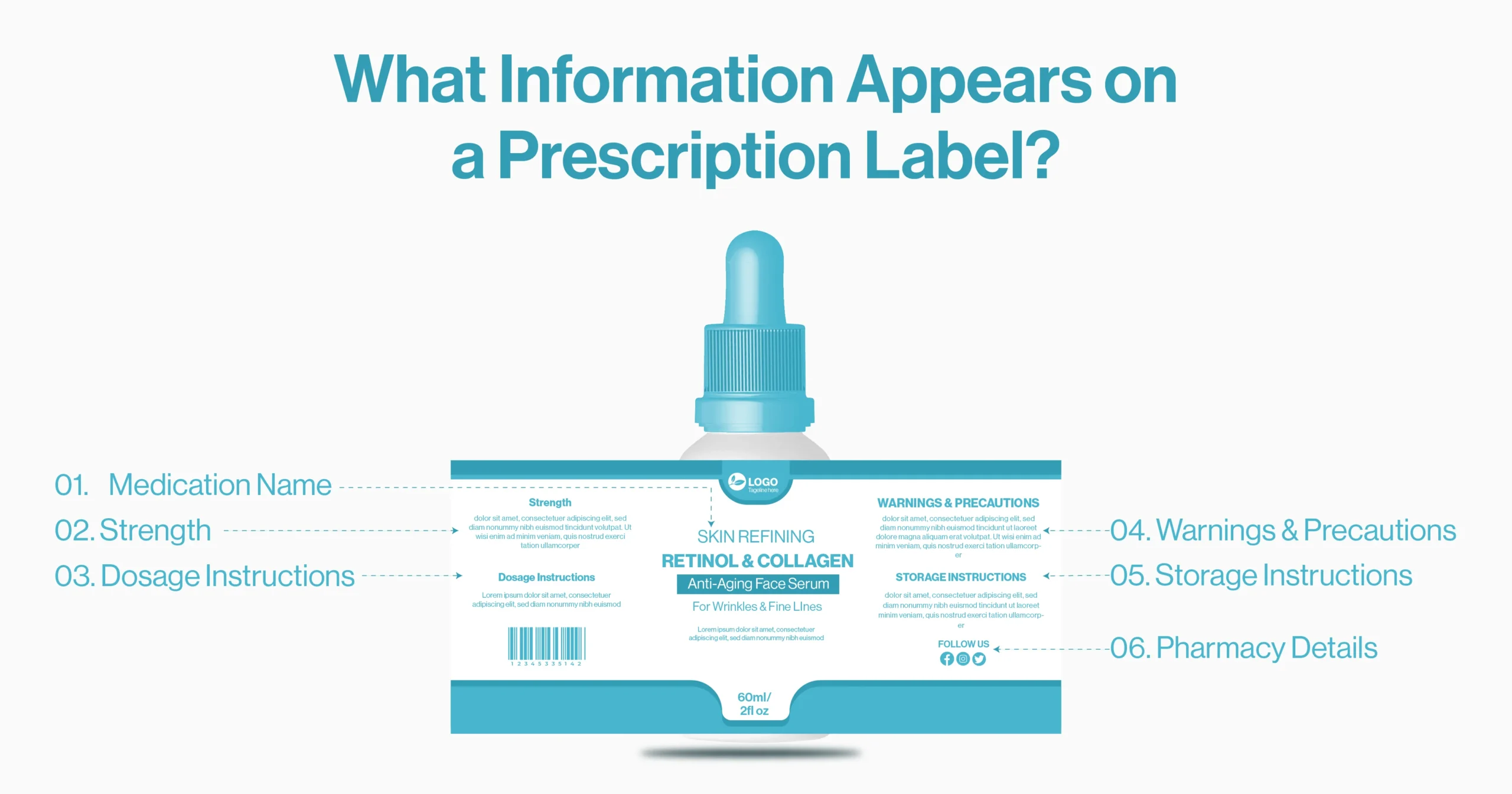
Before attempting to translate prescription labels into English, identify the main sections of the label. The exact layout varies by country and pharmacy, but several types of information commonly appear.
1. Medication Name and Strength
The medication name identifies the prescribed drug. It may include a generic name, a brand name, or both.
The strength indicates the amount of active ingredient in a specific unit, such as a tablet or a measured volume of liquid. Pay close attention to units such as milligrams (mg) and milliliters (mL), which are not interchangeable.
If the medication name or strength is difficult to read, ask a pharmacist to verify it before using the medicine.
2. Dosage and Administration Instructions
This section explains how the medication should be taken or applied. Instructions may specify the number of tablets, the amount of liquid, the route of administration, or the timing of each dose.
Some labels use abbreviations that may be unfamiliar or have different meanings depending on the context. Never guess the meaning of an abbreviation when it affects how a medication should be used.
3. Warnings and Precautions
Prescription labels may include warnings about food, alcohol, driving, allergies, or other medicines. Some medications also require specific storage conditions.
These warnings should be translated carefully because misunderstanding them may affect medication safety.
4. Pharmacy and Prescription Details
A label may also contain the patient’s name, pharmacy contact information, prescription number, refill details, and dispensing date.
These details can help a pharmacist identify the prescription and answer questions about the medication.
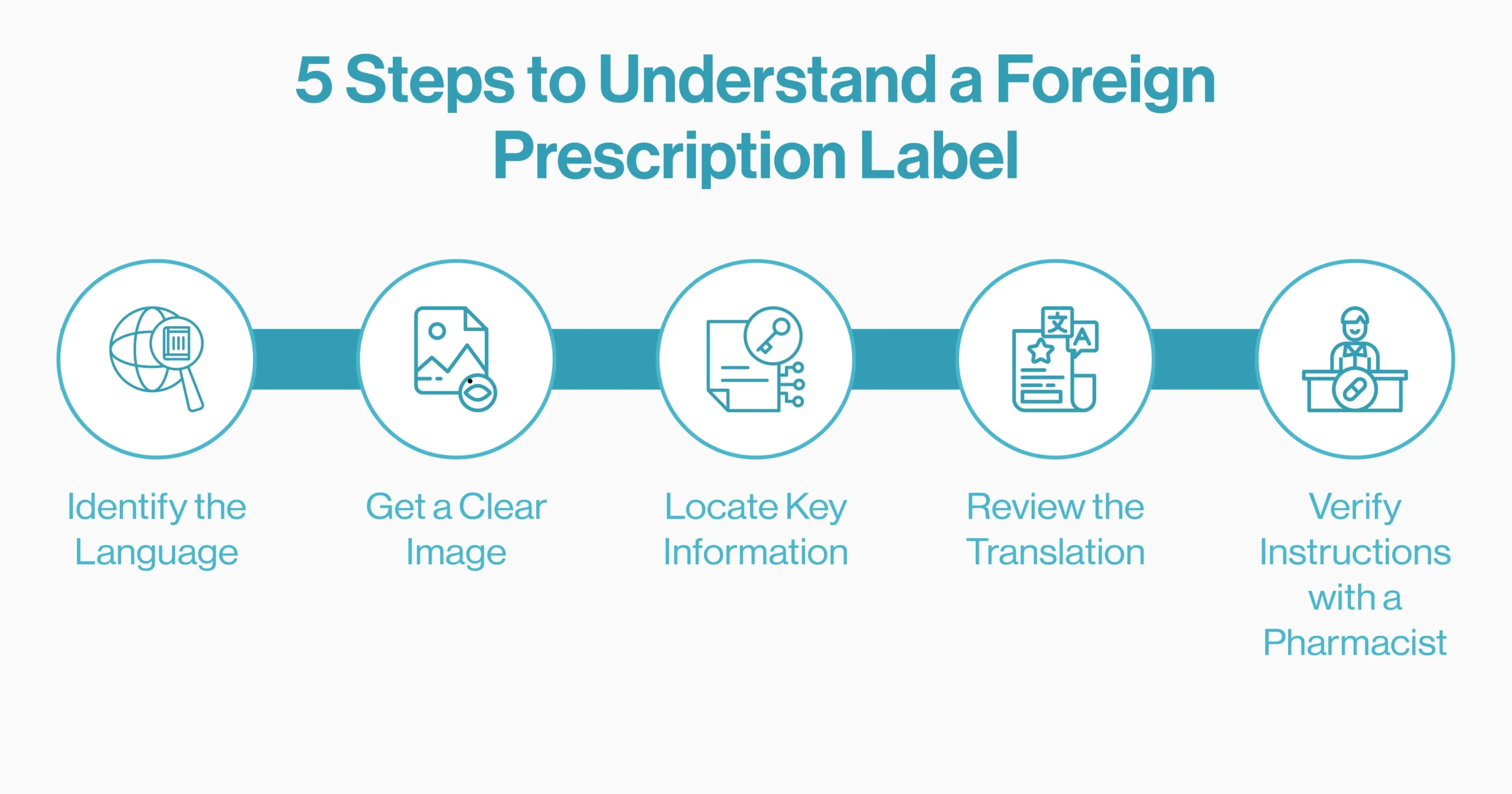
How to Translate Prescription Labels Into English Step by Step
If you need to translate prescription labels into English, follow a careful process that prioritizes accuracy over speed.
Step 1: Identify the Original Language
Determine which language the label uses. Some labels contain more than one language, while others combine local terminology with international medication names.
Identifying the language helps you select an appropriate translation resource or professional service.
Step 2: Obtain a Clear Copy of the Label
If you are using a digital translation tool for preliminary understanding, make sure the text is readable. Poor lighting, curved packaging, small fonts, and blurry photographs can cause words or numbers to be misread.
Do not assume that a tool has correctly recognized the text simply because it produces a fluent translation.
Step 3: Identify the Important Medication Information
Locate the drug name, strength, dosage instructions, warnings, and storage information. Check whether the label contains handwritten notes or abbreviations that may require professional interpretation.
Keep the original label available so the translated information can be checked against it.
Step 4: Review the Translation Carefully
A translation should preserve the original meaning without changing medication names, numerical values, units, or instructions.
If a dosage, warning, or abbreviation is ambiguous, do not try to resolve it through guesswork. Contact the dispensing pharmacy or a qualified healthcare professional.
Step 5: Confirm Unclear Instructions With a Pharmacist
Even a seemingly straightforward label can contain information that depends on the prescription and the patient’s circumstances.
A pharmacist can help verify the intended directions and explain unfamiliar terminology. If the label is damaged or incomplete, contact the pharmacy that dispensed the medication whenever possible.
Can Online Tools Translate Medication Labels?
Online translation tools can help users recognize general words and understand parts of a foreign-language label. However, they should not be treated as a reliable source for interpreting medication instructions without verification.
Automated tools may misread text in a photograph, confuse abbreviations, or produce an inaccurate translation of dosage directions. A small error involving a number, unit, or frequency can change the meaning of an instruction.
For this reason, people who want to translate prescription labels into English should treat automated results as preliminary information rather than confirmed medical guidance.
Before using any online tool, also consider privacy. Prescription labels may contain personal information, and uploading identifiable medical documents to an unfamiliar service may expose sensitive data.
If you cannot confidently understand the instructions, ask a pharmacist to review the original label and confirm how the medication should be used.
When Do You Need Professional Medical Translation?
Professional translation may be appropriate when a prescription label or related medical document needs to be understood accurately for healthcare, administrative, or official purposes.
A qualified medical translator can help communicate specialized terminology clearly while preserving the information in the original document. For safety-critical medication instructions, translation should be subject to appropriate review by a pharmacist or other qualified healthcare professional.
You may also need professional assistance when translating:
- Prescription documents from another country.
- Medication instructions accompanying medical records.
- Hospital discharge documents containing medication details.
- Medical reports required by a healthcare provider.
- Supporting documents for an official or administrative process.
If you need help with a broader medical document, ClickTrans offers information about professional medical translation services and considerations for selecting a suitable provider.
Keep in mind that translating a label does not replace medical advice or confirm that a medication is appropriate for a particular patient.
Common Mistakes to Avoid When Translating Prescription Labels
When attempting to translate prescription labels into English, avoid these common mistakes:
- Guessing unfamiliar abbreviations: Confirm their meaning with a pharmacist.
- Changing numbers or measurement units: Preserve the original information and have any uncertainty verified.
- Ignoring warnings: Translate precautions and restrictions as carefully as dosage instructions.
- Relying entirely on machine translation: Automated output can contain errors that are difficult for a non-specialist to recognize.
- Using an unclear photograph: Poor image quality can cause text recognition mistakes.
- Assuming the translated label is medically approved: Translation alone does not verify a prescription or determine whether the medication is suitable for you.
The safest approach is to confirm any unclear medication instruction with the dispensing pharmacy or another qualified healthcare professional before acting on it.
Frequently Asked Questions
How can I translate a prescription label into English?
You can use a translation tool to obtain a preliminary understanding of the text, but medication names, dosage instructions, abbreviations, and warnings should be verified by a pharmacist if anything is unclear.
Can Google Translate translate prescription labels?
Translation applications may recognize some words on prescription labels, but they can misread text or incorrectly translate medical abbreviations and dosage instructions. Do not rely on automated output alone to determine how to take a medication.
Is professional translation necessary for prescription labels?
Not every label requires a professional translator. However, professional assistance may be useful when the information is complex, the label is difficult to read, or the translation is needed for medical or official purposes. Medication instructions should be confirmed with a pharmacist when uncertain.
What should I do if I cannot understand my medication instructions?
Contact the pharmacy that dispensed the medication or ask a qualified healthcare professional to clarify the instructions. Do not guess the dosage or change how you take the medicine based on an uncertain translation.
Can I translate a prescription label from a photo?
A photo may help a translation tool recognize the text, provided the image is clear. However, image recognition can misread numbers, abbreviations, or small print. Verify important information with a pharmacist before relying on it.
Does translating a prescription label change the prescription?
No. Translation should communicate the original instructions, not change them. Any questions about dosage, timing, or the suitability of a medication should be directed to the prescribing clinician or pharmacist.