info@clicktranss.com


Table of Contents
Introduction
Healthcare communication can be a matter of life and death. Patients must understand diagnoses, treatment options, medication instructions, consent forms, and follow-up care recommendations to make informed decisions about their health. When language barriers exist, the risk of misunderstanding increases significantly, potentially affecting patient safety, treatment adherence, and healthcare outcomes.
The United States is home to diverse communities that speak hundreds of languages. Among them, Arabic-speaking populations continue to grow across many states, creating an increasing need for professional Arabic medical translation services. Healthcare providers, hospitals, clinics, pharmaceutical companies, and health insurance organizations must ensure that Arabic-speaking patients can access accurate and understandable healthcare information.
Professional Arabic medical translation goes beyond converting words from one language to another. It requires expertise in medical terminology, healthcare regulations, cultural nuances, and quality assurance processes. Accurate translations help patients understand critical healthcare information while helping providers communicate effectively and maintain high standards of care.
At ClickTrans, we specialize in Arabic medical translation services for healthcare organizations across the United States. Our experienced linguists help healthcare providers communicate confidently with Arabic-speaking patients through accurate, culturally appropriate, and industry-specific translations.
The Growing Need for Arabic Medical Translation in the United States
The Arabic-speaking population in the United States has expanded considerably over the past several decades. Communities of Arabic speakers can be found in major metropolitan areas and healthcare systems throughout the country. These communities include immigrants, refugees, international students, professionals, and families who may prefer receiving healthcare information in Arabic.
As healthcare organizations focus on improving patient experiences and expanding access to care, language accessibility has become increasingly important. While many Arabic-speaking individuals possess some level of English proficiency, healthcare information often contains highly technical language that can be difficult to understand even for native English speakers.
Medical terminology, legal disclosures, insurance documents, treatment plans, and surgical instructions require a level of precision that generic translation tools cannot reliably provide. Professional medical translation ensures that patients receive accurate information in a language they fully understand.
Why Language Access Matters in Healthcare
Language access is a critical component of patient-centered care. Effective communication allows healthcare providers to gather accurate information, explain treatment options, and ensure patients understand their responsibilities throughout the care process.
When communication barriers exist, healthcare providers may encounter several challenges:
- Difficulty obtaining complete medical histories
- Misunderstood treatment instructions
- Medication errors
- Delayed care
- Lower patient satisfaction
- Increased risk of readmission
Language access services help reduce these challenges and create a more inclusive healthcare environment.
Benefits of Effective Language Access
| Benefit | Impact |
| Improved Communication | Better understanding between providers and patients |
| Enhanced Safety | Reduced risk of medical errors |
| Better Compliance | Increased adherence to treatment plans |
| Higher Satisfaction | Improved patient experience |
| Better Outcomes | Increased engagement in healthcare decisions |
| Reduced Risk | Fewer communication-related complications |
Healthcare organizations that prioritize language access often experience stronger patient relationships and improved healthcare outcomes.
Risks of Inaccurate Medical Translation
Medical translation is one of the most specialized areas of professional translation. Errors can have serious consequences because healthcare information directly affects patient well-being.
A mistranslated medication instruction could result in improper dosage. An inaccurate consent form could leave patients unaware of important risks. Miscommunication regarding post-operative care could delay recovery or increase complications.
Common risks include:
- Incorrect medication use
- Misunderstood diagnoses
- Delayed treatment
- Incomplete informed consent
- Reduced trust in healthcare providers
- Potential legal exposure
Professional Arabic medical translators possess the expertise necessary to minimize these risks and maintain accuracy across healthcare communications.
Healthcare Documents That Require Arabic Translation
Healthcare organizations generate a wide range of documents that may need Arabic translation.
Common Medical Documents
| Document Type | Purpose |
| Medical Records | Clinical information and treatment history |
| Consent Forms | Authorization and informed consent |
| Intake Forms | Patient registration and medical history |
| Discharge Instructions | Recovery and follow-up care guidance |
| Medication Guides | Drug usage and safety information |
| Insurance Documents | Coverage and benefits information |
| Patient Education Materials | Health literacy and awareness |
| Clinical Trial Documents | Research participation information |
Accurate translation ensures patients can understand these materials and make informed healthcare decisions.
Arabic Translation for Hospitals and Health Systems
Hospitals are among the largest consumers of healthcare translation services. Every department within a hospital relies on effective communication to deliver quality care.
Arabic translation services support:
- Emergency departments
- Inpatient care units
- Surgical departments
- Oncology centers
- Cardiology clinics
- Rehabilitation programs
- Outpatient services
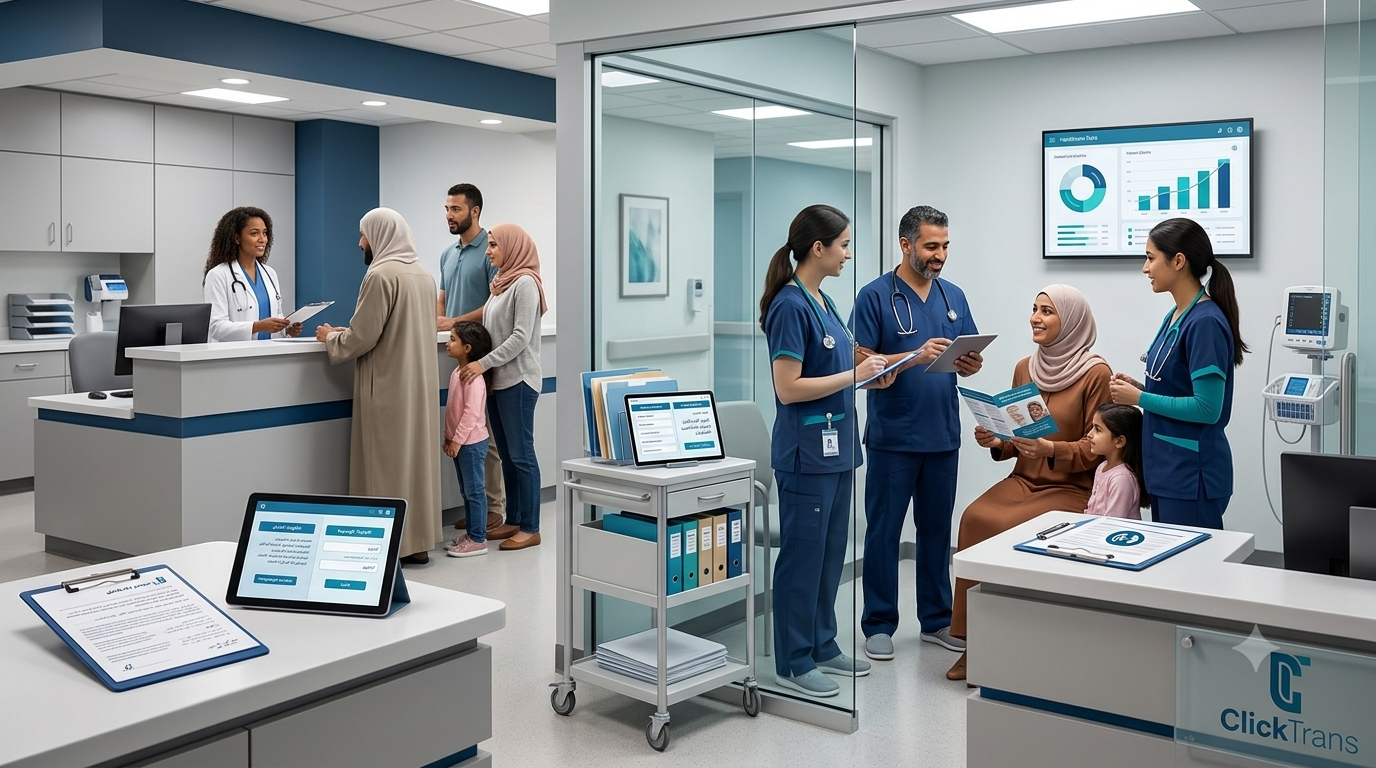
Hospitals frequently require translation of consent forms, patient rights documentation, discharge instructions, educational resources, and digital healthcare content.
Organizations that provide translated materials often improve patient understanding and engagement throughout the care process.
For a deeper look at hospital-specific language access needs, read our guide: Why U.S. Hospitals Need Professional Arabic Translation Services for LEP Patients.
Arabic Translation for Clinics and Medical Practices
Private practices and community clinics also benefit from professional Arabic translation services. Smaller healthcare organizations often serve multilingual communities and must communicate effectively with patients throughout every stage of care.
Translated materials may include:
- Appointment reminders
- Intake forms
- Treatment plans
- Preventive care information
- Follow-up instructions
Providing information in Arabic helps strengthen patient trust and encourages active participation in healthcare decisions.
Arabic Translation for Mental Health Providers
Mental health communication requires exceptional accuracy and cultural sensitivity. Patients discussing emotional, psychological, or behavioral concerns need to feel understood and supported.
Arabic translation can assist mental health providers with:
- Patient assessments
- Educational materials
- Therapy resources
- Treatment plans
- Intake documentation
Professional translation helps ensure that mental health information is communicated clearly and respectfully.
Arabic Translation for Pharmaceutical Companies
Pharmaceutical organizations rely heavily on accurate translation to communicate with patients, healthcare professionals, and research participants.
Common pharmaceutical translation projects include:
- Medication guides
- Drug labeling
- Clinical trial documentation
- Patient recruitment materials
- Safety information
- Regulatory submissions
Errors in pharmaceutical translation can affect patient safety and regulatory compliance, making professional linguistic expertise essential.
Arabic Translation for Medical Device Manufacturers
Medical device companies frequently require multilingual documentation for products used in healthcare environments.
Examples include:
- User manuals
- Safety instructions
- Product specifications
- Training materials
- Regulatory documentation
Professional translation ensures healthcare professionals and patients understand how to use devices safely and effectively.
Human Translation vs Machine Translation in Healthcare
Artificial intelligence and machine translation technologies have improved significantly in recent years. However, healthcare remains one of the fields where human expertise is essential.
Medical terminology often depends on context, patient circumstances, and industry-specific language. Automated tools may misinterpret terminology or fail to capture critical nuances.
Professional human translators provide:
- Terminology accuracy
- Contextual understanding
- Cultural adaptation
- Quality assurance
- Industry expertise
For healthcare communication, human review remains a critical component of quality and patient safety.
Benefits of Professional Arabic Medical Translation
Healthcare organizations that invest in professional Arabic translation services gain numerous advantages.
Key Benefits
- Improved patient safety
- Better treatment adherence
- Increased patient satisfaction
- Stronger community engagement
- Greater healthcare accessibility
- Reduced communication risks
- Enhanced organizational reputation
These benefits contribute to a more effective and inclusive healthcare environment.
Why Healthcare Organizations Choose ClickTrans
Healthcare translation requires more than language skills. It requires an understanding of medical terminology, healthcare workflows, confidentiality requirements, and quality standards.
ClickTrans provides specialized Arabic medical translation services for healthcare organizations across the United States. Our experienced linguists understand the complexities of healthcare communication and deliver accurate translations tailored to the needs of healthcare providers.
Our services support:
- Hospitals
- Clinics
- Medical practices
- Pharmaceutical companies
- Medical device manufacturers
- Health insurance organizations
- Healthcare technology providers
By combining linguistic expertise with healthcare knowledge, ClickTrans helps organizations communicate confidently with Arabic-speaking patients and stakeholders.
Frequently Asked Questions
Why is professional medical translation important?
Medical translation helps ensure patients understand critical healthcare information, reducing communication risks and supporting informed decision-making.
What documents commonly require Arabic translation?
Common documents include medical records, consent forms, discharge instructions, medication guides, insurance materials, and patient education resources.
Can machine translation be used for medical content?
Machine translation may assist with basic communication, but healthcare content should always be reviewed by qualified human translators due to the complexity and sensitivity of medical information.
How does Arabic translation improve patient care?
Accurate translation helps patients understand diagnoses, treatments, medications, and follow-up instructions, supporting better healthcare outcomes.
Conclusion
As healthcare organizations continue serving increasingly diverse communities, effective communication remains essential to quality care. Arabic-speaking patients deserve access to healthcare information they can understand, and healthcare providers benefit from tools that improve communication, patient engagement, and treatment adherence.
Professional Arabic medical translation services help bridge language gaps, support patient safety, and create more inclusive healthcare experiences. Whether translating medical records, consent forms, patient education materials, or pharmaceutical documentation, accuracy and cultural understanding are critical.
ClickTrans is proud to support healthcare organizations throughout the United States with professional Arabic medical translation services that help improve communication, compliance, and healthcare outcomes.