info@clicktranss.com



Table of Contents
The field of special education can be complicated, particularly when there are language barriers
Although the Individualized Education Program (IEP) serves as a beacon of support and customization for students with special needs, it is essential to ensure effective communication through IEP translation services.
From its fundamental concepts to the stages of its development and implementation, this piece will guide you through the fundamentals of IEPs.
You will have a better grasp of how IEPs operate and how they may be used to foster a more inclusive and encouraging learning atmosphere for all children by the conclusion of this handbook.
What is the meaning of IEP?
A legally binding document called an Individualized Education Program (IEP) is created to address the specific educational requirements of students with impairments. It details the precise aims, accommodations, and services necessary for the student’s educational path. A team consisting of teachers, special education experts, and the child’s parents or caregivers works together to create the IEP.
IEP Translation Services
The process of translating an IEP involves more than simply transcribing words from one language to another. It’s about cultural sensitivity, precision, and comprehension of the subtleties of both languages. Accurate and culturally responsive individualized education program translation services are essential for students who are English Language Learners (ELLs) or LEP.
In order to be genuinely engaged in decision-making and assisting their child in learning, parents and guardians must have a thorough understanding of the IEP’s content. A skilled translator can save a life by ensuring that everyone comprehends one another and that the team functions effectively.
What do IEP translation services include?
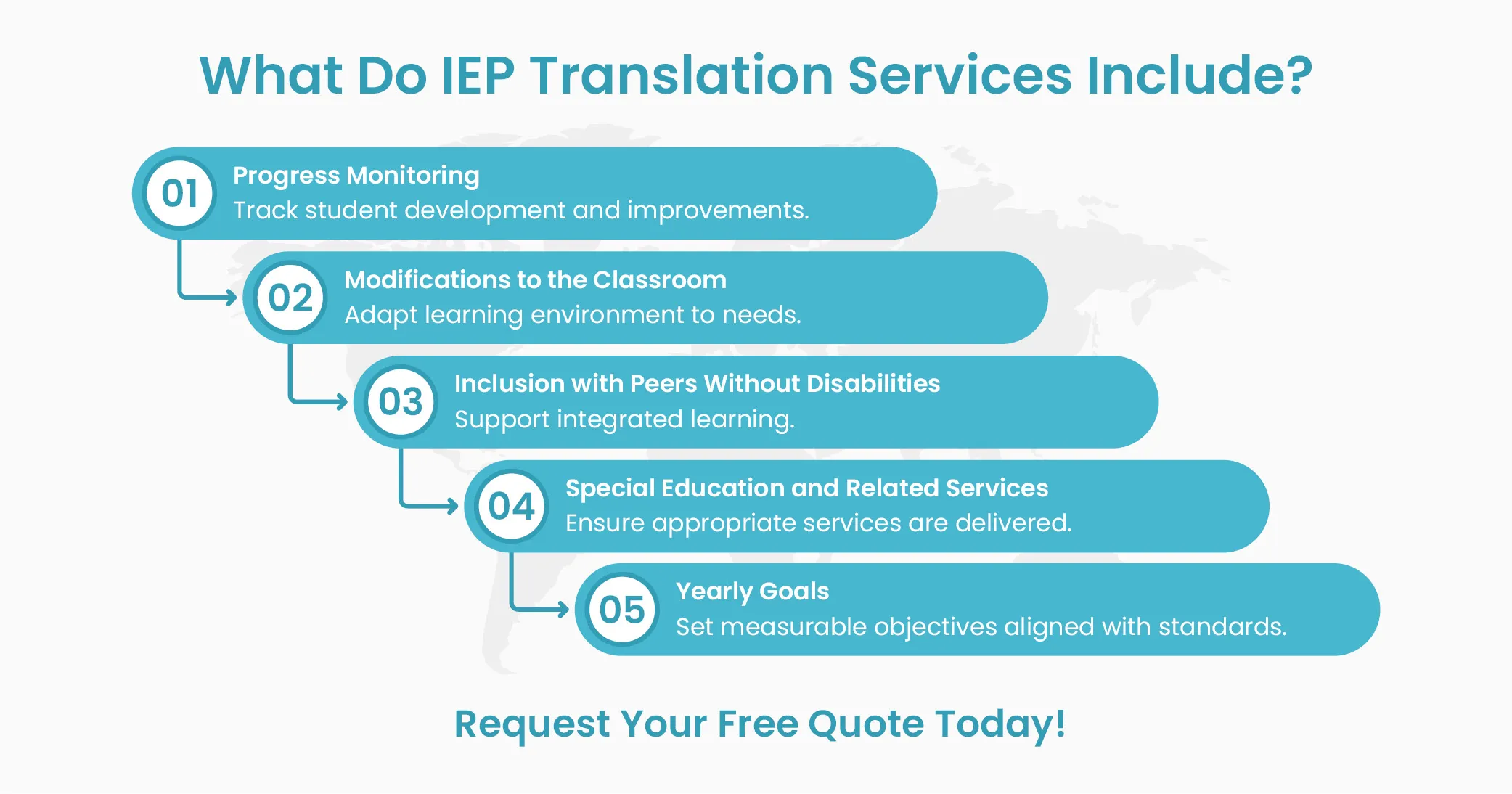
A number of crucial elements must be included in the IEP translation services to guarantee that it adequately meets the individual requirements of the learner:
The child’s point of departure:
A thorough assessment of their present academic, social, and developmental abilities. This aids in determining areas of strength and weakness, laying the groundwork for goal-setting.
Yearly goals:
Measurable goals that specify the academic and practical advancement the student is predicted to make in a year. These objectives should be consistent with district and state standards and suited to the unique needs of the youngster as outlined in their IEP.
Special Education and Related Services:
A comprehensive overview of the Specific Instruction and support services the student will get, such as speech-language therapy, occupational therapy, or physical therapy. The purpose of these services is to meet the child’s identified needs and assist them in working toward their IEP objectives.
Inclusion with peers without disabilities:
A strategy for making sure the student is included in the general education environment as much as is possible. This element highlights the need for creating possibilities for pupils with disabilities to engage with their non-disabled peers.
Modifications to the classroom:
Particular alterations to the learning environment or teaching strategies to facilitate your child’s access to and success in the curriculum. This may include adjusted evaluations, assistive technology, or longer assignment times.
Progress Monitoring:
Methods for routinely evaluating the student’s progress toward their yearly objectives. This information is used to evaluate the efficacy of the IEP and make any needed changes to the plan.
What are the benefits of IEP Translation Services?
Because inclusive education is essential for integrating students with disabilities into society, IEP translation services play a crucial role in helping parents clearly understand their child’s progress, evaluations, and support plan.
Improved communication:
Guarantees that parents comprehend all aspects of their child’s IEP.
Engaged parents:
Parents have the opportunity to be more engaged in their child’s education and collaborate with the school.
Enhances student results:
Improves academic performance and promotes stronger educational assistance.
Adherence to legal requirements:
Supports schools in fulfilling their responsibilities under federal and state law.
Why Choose ClickTrans for IEP Translation Services?
Choosing ClickTrans for your IEP translation services mean you’re relying on a service that understands the importance of accuracy, clarity, and sensitivity in this type of document. With a team of professional translators and a reliable workflow, ClickTrans guarantees an accurate translation that meets your child’s educational needs.
Knowledge of Education
Over years of expertise translating academic materials.
Private and safe
Your privacy and the safety of your documents are our top priorities.
Prompt Delivery
Quick response to critical educational demands.
Certified Translators
We have certified experts on our team that are fluent in the vocabulary of education.
Read More: Arabic Translation for NGOs.
Conclusion
IEP translation services make certain that families with little English competency can fully comprehend their child’s IEP and actively participate in their child’s educational plan. Effective communication and parental comprehension are achieved by translating the IEP and supporting materials, which encourages parents to engage in their child’s education.
ClickTrans is excited about the possibility of collaborating with your school to make sure IEP plans are effective and have a beneficial impact on students’ academic performance. Our experience working with schools on IEP translation and interpretation gives us confidence that your school will also have a good experience.
Read More: Grant Proposal Translation Services.
FAQs
What is an IEP and why does it matter?
A legally enforceable agreement known as an IEP is created for kids who qualify for special education. It specifies the student's existing academic standing, yearly objectives, necessary special education services, accommodations and adjustments, as well as involvement in general education.
Who creates the IEP?
An IEP is produced by a group that generally consists of educators, school psychologists, therapists (if any), and other professionals. the student (if applicable), the parents or guardians, and the student.
What does an IEP aim to accomplish?
A student with a disability is guaranteed a customized education that addresses their specific needs by an IEP, and it's a guide to ensuring the student's legal rights and making educational gains.
Why is it necessary to translate IEPs?
Language access is essential. It is imperative that non-English-speaking parents are able to comprehend and be actively involved in their child's education. Translation eliminates obstacles, encourages teamwork, and guarantees adherence to federal law.